
Best Time to Visit
Best Time to Visit Morocco: Month-by-Month Guide
Discover the best time to visit Morocco, month by month: weather, crowds, prices, festivals, Sahara trips, Toubkal hikes, surf and Ramadan tips.
TRAVSUS
· 13 min read

Ask ten travelers about the best time to visit Morocco and you may hear ten different answers. That is because, climate-wise, Morocco is several countries in one. On the same day in January you can sip mint tea in a sunny Marrakech garden, watch snow fall on the High Atlas, ride a camel across cold, crystal-clear Sahara dunes and surf a warm Atlantic swell near Taghazout. The right month for you depends on what you want to see, how you handle heat, and whether you prefer lively festivals or quiet medinas.
This month-by-month guide, written by the team that plans private tours across Morocco every day of the year, breaks down the weather in Marrakech, Fes, the coast, the Sahara and the Atlas Mountains, along with crowds, prices, festivals and practical tips.
Morocco at a Glance: Quick Facts on Timing
Best overall months: March to May and late September to November, when most regions are warm, sunny and comfortable.
Best for the Sahara Desert: October to April, with mild days; bring warm layers for cold desert nights.
Best for hiking Toubkal: May to June and September to October, when trails are mostly free of snow.
Best for beaches and surfing: June to September for beach days; October to April for the most consistent surf.
Best for skiing: roughly January to March at Oukaimeden, depending on snowfall.
Hottest months: July and August, when Marrakech and Fes often pass 37°C and the desert can exceed 45°C.
Cheapest months: January (after New Year), February and the height of summer inland.
Busiest periods: Easter, spring school holidays, October, and Christmas to New Year.
Ramadan: moves about 10 to 11 days earlier each year; in 2027 it is expected to fall roughly from early February to early March.
Understanding Morocco's Climate Zones
Before diving into the months, it helps to understand why Morocco's weather varies so much. The country is shaped by the Atlantic Ocean to the west, the Mediterranean to the north, the Atlas mountain ranges running through its center, and the Sahara to the southeast.
Imperial Cities: Marrakech, Fes, Meknes and Rabat
Marrakech and Fes have a semi-arid, continental feel: hot, dry summers and mild, sunny winters with chilly nights. Marrakech is generally a little warmer and drier, while Fes, further north, gets more winter rain and can feel damp and cold in December and January. Rabat and Casablanca, on the coast, stay milder all year thanks to the ocean.
The Atlantic Coast: Essaouira, Agadir and Taghazout
The coast enjoys one of the most pleasant climates in North Africa. Essaouira rarely gets very hot or very cold, with daytime temperatures hovering around 18–23°C for much of the year, although its famous trade winds blow strongly in summer. Further south, Agadir and Taghazout are sunnier and warmer, with comfortable winters that attract Europeans escaping the cold.
The Sahara: Merzouga and Zagora
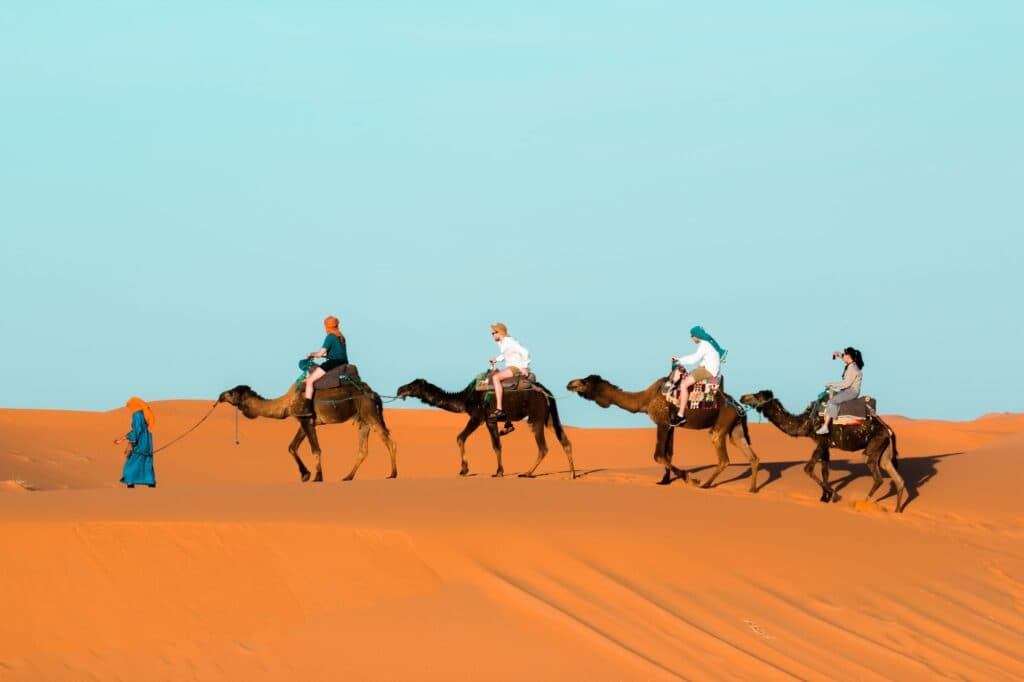
The desert is a land of extremes. Winter days are pleasantly warm, but nights can drop close to freezing. Summer days are fierce, often above 45°C at Erg Chebbi near Merzouga. Spring can bring sandstorms when hot winds pick up, while autumn tends to be calm and golden.
The Atlas Mountains: High Atlas, Middle Atlas and Anti-Atlas
Altitude changes everything. In the High Atlas, villages like Imlil (around 1,750 m) are cool and green in spring and fresh in summer, while peaks such as Jebel Toubkal (4,167 m) are snow-capped from roughly December to April. The Middle Atlas, around Ifrane and Azrou, is famous for cedar forests, Barbary macaques and occasional winter snow.
Morocco Season by Season
Spring (March to May): The Sweet Spot
Spring is widely considered the best time to visit Morocco. The countryside turns green after the winter rains, wildflowers cover the hills, almond and orange trees blossom, and temperatures in Marrakech sit comfortably in the mid-20s °C. It is ideal for combining cities, mountains and the desert in one trip. The downside is popularity: Easter and European spring holidays bring higher prices and busier riads.
Summer (June to August): Coast and Mountains
Summer is hot inland. Marrakech and Fes regularly reach the high 30s °C and occasionally top 40°C, and the Sahara is best limited to sunrise and sunset. However, this is a great season for the Atlantic coast, where the breeze keeps Essaouira cool, and for the High Atlas, where valleys offer welcome relief. Summer is also the main holiday season for Moroccan families and the diaspora, so beach towns become lively.
Autumn (September to November): Golden and Calm
Autumn rivals spring as the best season. The heat fades by late September, the light becomes soft and golden, and desert nights are still mild enough for comfortable camping. It is date harvest season in the oases and a fantastic time for trekking. October is especially popular, so book private tours and desert camps early.
Winter (December to February): Sunshine and Snow
Winter surprises many visitors. Days are often sunny and mild in Marrakech (around 18–20°C), but evenings are chilly and many traditional riads are not fully heated. Snow covers the High Atlas, making for stunning drives over the Tizi n'Tichka pass, which can close briefly after heavy snowfall. Outside the Christmas and New Year rush, winter offers some of the best prices and the fewest crowds of the year.
Morocco Month-by-Month: Weather, Crowds and Events
The temperatures below are approximate average daytime highs and night-time lows. Actual conditions vary from year to year, so always check a forecast before you travel.
January
January is cool and generally dry. Marrakech sees highs around 18°C and lows near 6°C, while Fes is a bit colder at around 16°C by day and 4°C at night. The coast stays mild, with Agadir often reaching 20°C. In the Sahara, sunny days of about 17–19°C give way to nights near or below freezing, so desert camps provide heavy blankets. The High Atlas is snowy. After the New Year holidays, crowds thin and prices drop. The Amazigh (Berber) New Year, Yennayer, is celebrated around 13–14 January and has recently become an official public holiday.
February
February is similar to January but slowly warming, with Marrakech around 20°C. It is one of the quietest and best-value months, and a great time for skiing at Oukaimeden when snow cover is good. In the Anti-Atlas, the town of Tafraoute traditionally celebrates the almond blossom, which paints the valleys white and pink. Note that Ramadan is expected to start in early February in 2027, which affects daily rhythms (see our Ramadan section below).
March
March marks the beginning of spring. Marrakech reaches around 23°C, Fes about 20°C, and the desert offers warm days and cool nights. Rain showers are possible in the north, but the landscapes are at their greenest. Orange blossoms begin to scent the gardens of Marrakech. Occasional winds can raise sand in the Sahara. Crowds start to build toward the end of the month, especially around European school holidays.
April
April is one of the finest months of the year. Expect around 25°C in Marrakech, 22°C in Fes and pleasant warmth in the desert, while the High Atlas valleys are lush and full of blossoming fruit trees. Because Easter often falls in April, this is a peak period, with higher prices and fuller hotels. Book your riad, desert camp and private driver well in advance.
May
May brings warm, settled weather: about 28°C in Marrakech and Fes, with the desert starting to heat up to the low 30s °C. It is an excellent month for hiking, as snow retreats from the high trails. In the Dades Valley region, the town of Kelaat M'Gouna usually holds its famous Rose Festival in May, celebrating the harvest of the fragrant Damask rose. Festivals in Fes and Rabat often take place in late May or June too.
June
June is the start of summer. Marrakech climbs to around 33°C and the desert to 38°C or more. The coast is delightful, with Essaouira around 22°C. Essaouira traditionally hosts the Gnaoua World Music Festival around June, filling the town with music and visitors, so plan ahead if you want to attend. The Fes Festival of World Sacred Music is also typically held in late spring or early summer. Mountain treks are excellent, with long days and clear skies.
July
July is hot. Marrakech often reaches 37–38°C, Fes is similar, and the Sahara can exceed 45°C. If you visit the desert, stay in a well-shaded camp, plan camel rides for sunrise and sunset, and rest in the middle of the day. The best escapes are the Atlantic coast and the High Atlas, where Imlil and the Ourika Valley stay much cooler. Throne Day on 30 July is a national holiday.
August
August is the hottest and one of the busiest months for domestic tourism, as Moroccan families and relatives returning from Europe head to the coast. Beach towns like Agadir, Essaouira and the Mediterranean resorts are lively and more expensive. Inland cities are quieter and sometimes cheaper. In late August or September, the High Atlas village of Imilchil traditionally hosts its well-known engagement and marriage gathering, a fascinating cultural event.
September
September is a transition month. The first half can still be hot (around 33°C in Marrakech), but temperatures ease as the month goes on. The sea is at its warmest, making early September perfect for a beach extension. By late September, Sahara trips become comfortable again. This is also a great month for trekking Toubkal before the first autumn snows.
October
October is arguably the best all-round month. Marrakech sits around 27–28°C, Fes around 25°C, the desert is warm by day and pleasant at night, and the surf season on the Atlantic coast begins to pick up. Oases harvest their dates, and Erfoud, near Merzouga, traditionally celebrates the harvest with a Date Festival. Demand is high, so this is a month to book private tours and desert camps early.
November
November is mild and quieter. Marrakech sees around 22°C by day, with cooler evenings, and the first rains may arrive in the north. Desert days are perfect for exploring, though nights get cold. Two national holidays, Green March Day (6 November) and Independence Day (18 November), bring local celebrations. The Marrakech International Film Festival is usually held in late November or early December.
December
December is cool and often sunny, with Marrakech around 19°C by day and 7°C at night. Snow returns to the High Atlas, creating beautiful scenery. The first half of the month is calm and good value, but the Christmas and New Year period is one of the busiest of the year, especially for Sahara camps and Marrakech riads, so reserve months ahead. Spending New Year's Eve under the desert stars is an unforgettable experience.
Best Time for Specific Experiences
Best Time to Visit the Sahara Desert
For most travelers, the ideal window for a Sahara trip to Merzouga or Zagora is October to April. Days are warm and sunny, and the night sky is breathtaking. In December and January, nights can be close to freezing, so pack a warm jacket, hat and thermal layers. Spring is beautiful but can bring wind and sandstorms, especially in March and April. Summer desert trips are possible, but only for travelers comfortable with intense heat; plan activities early and late in the day.
Best Time to Hike Toubkal
Jebel Toubkal, North Africa's highest peak at 4,167 m, is best climbed in May, June, September and October. In these months the trail from Imlil to the refuge and the summit is usually free of snow, and conditions are stable. July and August are possible, though valleys are hot and afternoon storms can develop. From roughly December to April, the mountain is a winter climb requiring crampons, an ice axe, experience and a qualified mountain guide.
Best Time for Beaches and Surfing
For swimming and sunbathing, aim for June to September, when the Atlantic is at its warmest (still refreshing, around 20–22°C). Agadir is the sunniest beach destination, while Essaouira is cooler and windier, which makes it a paradise for kitesurfing and windsurfing. For surfing, the best and most consistent waves in Taghazout and Imsouane typically arrive between October and April, when Atlantic swells roll in.
Best Time for Skiing at Oukaimeden
Few people know you can ski in Africa just over an hour from Marrakech. Oukaimeden, at around 2,600 m, usually has its best snow between January and March, although conditions vary greatly from year to year. Facilities are simple, but skiing above palm-filled plains is a unique experience.
Best Time for City Breaks and Imperial Cities
Marrakech, Fes, Meknes, Rabat and Chefchaouen are most comfortable in spring and autumn. Winter is also a pleasant and economical option for sightseeing, as long as you pack for cold evenings. In summer, explore early in the morning and evening and spend the afternoon by the riad pool.
Traveling to Morocco During Ramadan
Ramadan follows the Islamic lunar calendar, so it moves about 10 to 11 days earlier each year. In 2027 it is expected to run from approximately early February to early March, and in 2028 from late January to late February. Exact dates depend on the sighting of the moon and are confirmed shortly before.
Traveling during Ramadan is absolutely possible and can be a rewarding experience. During daylight hours, many Muslims fast from food and drink, so some cafés and restaurants close or reduce their hours, and the pace of life slows down. After sunset, cities come alive as families break the fast with ftour, often including harira soup, dates and sweets. Tourist restaurants, hotels and riads continue to serve visitors. Be respectful by avoiding eating, drinking or smoking openly in the street during the day, and expect some shops and monuments to have shorter opening hours. The celebration of Eid al-Fitr at the end of the month is joyful, but transport can be busy.
What to Pack for Each Season
Spring and Autumn
Light layers, such as T-shirts, long-sleeved shirts and a light sweater or fleece
A warm jacket for the desert and mountain evenings
Comfortable walking shoes for medinas and trails
Sunglasses, sun hat and high-factor sunscreen
Summer
Loose, breathable clothing in cotton or linen that covers shoulders and knees
A wide-brimmed hat and a scarf to protect against sun and dust
A reusable water bottle and electrolyte sachets
Swimwear for the coast or riad pools, plus a light layer for the mountains
Winter
A warm coat, a hat and gloves, especially for the Sahara and the Atlas
Thermal layers and warm socks for chilly riads and desert camps
Waterproof shoes and a rain jacket for Fes and the north
Sunscreen and sunglasses, because winter sun is still strong
Year-round, modest clothing is appreciated, especially in rural areas, and a light scarf is always useful.
Frequently Asked Questions About the Best Time to Visit Morocco
What is the best month to visit Morocco?
If we had to choose just one, it would be April or October. Both months offer warm, sunny days in the cities, comfortable conditions in the Sahara and good hiking in the Atlas. They are also popular, so book early.
Is Morocco too hot in summer?
Inland areas such as Marrakech, Fes and the Sahara are very hot in July and August, often reaching 37°C or more. However, the Atlantic coast and the High Atlas remain pleasant. With early starts, midday rest and air-conditioned private transport, summer trips can still be very enjoyable.
Does it snow in Morocco?
Yes. The High and Middle Atlas regularly receive snow in winter, usually from December to March. Towns like Ifrane and Imlil can be covered in white, and Oukaimeden offers skiing in good years. Snow in Marrakech itself is extremely rare.
When is the cheapest time to visit Morocco?
The best prices are usually found in January and February (outside holiday periods) and in the summer months for inland destinations. Prices are highest around Christmas and New Year, Easter and October.
Is it worth visiting Morocco in winter?
Absolutely. Winter brings sunny days, fewer crowds, lower prices, snow-capped mountain views and magical, starry desert nights. Just pack warm clothing for evenings and nights, especially in the Sahara.
How many days do I need for a Sahara trip from Marrakech?
Merzouga is a long drive from Marrakech, so we recommend at least three days, and ideally four or more, to enjoy the Atlas crossing, Aït Benhaddou, the Dades and Todra gorges and a night in a desert camp without rushing.
Is it a good idea to visit Morocco during Ramadan?
Yes, as long as you are flexible and respectful. Tourist services operate normally, evenings are festive and atmospheric, and you will experience a special side of Moroccan culture. Daytime can be quieter, with some reduced opening hours.
Plan Your Trip at the Perfect Time with Travsus
There is no single best time to visit Morocco, only the best time for you. Whether you dream of a winter night under the Sahara stars, a spring road trip through blooming Atlas valleys, an autumn trek to the summit of Toubkal or a summer escape to the breezy Atlantic coast, timing makes all the difference.
At Travsus, we design private tours from Marrakech, Fes, Casablanca, Tangier and beyond, to the Sahara Desert, the Atlas Mountains, the imperial cities and the coast. Our local drivers and guides know how each season shapes the roads, the weather and the experiences, and we adapt every itinerary to the month you travel, from the best camp for cold desert nights to the best hours to explore in summer. Tell us when you would like to travel and what you dream of seeing, and we will create a tailor-made Morocco tour that makes the most of every day.
- Best Time to Visit
- Morocco Weather
- Sahara Desert
- Morocco Travel Guide