
Morocco Itinerary
10 Days in Morocco Itinerary: The Perfect Grand Tour
Plan the perfect 10 days in Morocco: day-by-day itinerary from Casablanca to Chefchaouen, Fes, the Sahara and Marrakech, with costs, tips and FAQ.
TRAVSUS
· 14 min read

Ten days is the sweet spot for a first trip to Morocco. It is long enough to see the country's great contrasts – Atlantic cities, the blue mountain town of Chefchaouen, the medieval maze of Fes, the golden dunes of the Sahara, the kasbahs of the south and the irresistible energy of Marrakech – without feeling like you are living in a car. It is also short enough that a badly planned route will cost you precious days in transit.
This guide gives you a tried-and-tested 10 days in Morocco itinerary built around a classic grand loop, with realistic driving times, where to sleep each night, what it costs, when to go and how to adapt the route for luxury travellers, families and adventure seekers. It is the same logic our drivers and guides at Travsus use every week when they plan private tours across the country.
Morocco in 10 Days at a Glance
Route: Casablanca → Rabat → Chefchaouen → Fes → Merzouga (Sahara) → Todra & Dades Gorges → Ait Ben Haddou & Ouarzazate → Marrakech (optional Essaouira day trip).
Total distance: roughly 1,800–2,000 km by road.
Best for: first-time visitors who want cities, mountains and desert in one trip.
Best time to go: March to May and late September to November.
Ideal transport: a private driver in an air-conditioned 4x4 or minivan, or a self-drive rental for confident drivers.
Arrival / departure: fly into Casablanca (CMN) and out of Marrakech (RAK) to avoid backtracking.
Approximate budget: from about €900 per person (mid-range, sharing) to €3,000+ for a luxury private tour, excluding international flights.
Highlight of the trip: a night in a desert camp under the stars at Erg Chebbi.
Why This Route Works
Morocco's main sights form a natural loop. Starting in the north on the Atlantic coast and finishing in Marrakech means you never retrace your steps, you cross the Middle Atlas and High Atlas mountains in daylight, and you reach the Sahara in the middle of the trip, when you are rested enough to enjoy it. Ending in Marrakech is also practical: it has the most international flight connections and the best choice of riads for a relaxing finale.
The route can be run in reverse (Marrakech to Casablanca) with exactly the same nights. If you can only fly in and out of Marrakech, you can still do it: simply add a transfer day from Marrakech to Casablanca by train (about 2.5–3 hours) at the start.
The Day-by-Day 10-Day Morocco Itinerary
Day 1: Arrival in Casablanca – Hassan II Mosque and the Corniche
Land at Mohammed V International Airport and transfer to the city (about 40 minutes). After checking in, head straight for the Hassan II Mosque, one of the very few mosques in Morocco open to non-Muslim visitors on guided tours. Its minaret is among the tallest in the world and the prayer hall is built partly over the ocean – the craftsmanship in carved cedar, zellige tile and stucco is a perfect introduction to Moroccan art.
In the late afternoon, stroll along the Corniche in Ain Diab and enjoy fresh seafood for dinner. If you arrive early, the Habous quarter and the Art Deco buildings of the city centre are worth an hour.
Overnight: Casablanca. Tip: check the mosque's guided tour times in advance, as they change on Fridays and during Ramadan.
Day 2: Rabat, Then on to Chefchaouen
Driving time: Casablanca to Rabat about 1 hour 15 minutes; Rabat to Chefchaouen about 4 hours.
Morning in Rabat, Morocco's calm and elegant capital. Visit the Hassan Tower and the marble Mausoleum of Mohammed V with its guards in ceremonial uniform, then wander the whitewashed lanes of the Kasbah of the Udayas above the mouth of the Bou Regreg river. After lunch, drive north through farmland and the foothills of the Rif mountains to Chefchaouen, arriving in time for golden-hour light on the blue walls.
Overnight: Chefchaouen.
Day 3: Exploring Chefchaouen, the Blue Pearl
Give yourself a full day here. Chefchaouen's medina is small, safe and made for slow wandering: blue staircases, potted geraniums, weavers' workshops and the shaded main square, Plaza Uta el-Hammam, dominated by the red-walled kasbah. Go early in the morning for empty streets and the best photos.
In the afternoon, walk up to the Spanish Mosque on the hill east of town (around 30 minutes each way) for sunset over the valley. Nature lovers can instead take a half-day trip to the Akchour waterfalls in Talassemtane National Park, about 45 minutes away by road.
Overnight: Chefchaouen.
Day 4: Chefchaouen to Fes via Volubilis
Driving time: about 4–4.5 hours including the detour.
Leave after breakfast and head south to Volubilis, the best-preserved Roman site in Morocco and a UNESCO World Heritage Site. Its mosaics, triumphal arch and basilica columns stand in open countryside with wide views. Nearby, the holy town of Moulay Idriss Zerhoun spills down two hills and makes a great photo stop. If time allows, add a short visit to Meknes to see the monumental Bab Mansour gate before continuing to Fes for the evening.
Overnight: Fes (first of two nights).
Day 5: A Full Day in the Fes Medina
Fes el-Bali is one of the largest car-free urban areas in the world and the spiritual heart of Morocco. With roughly 9,000 lanes and alleys, this is the one place where a licensed local guide is genuinely worth it. Highlights include the Bou Inania Madrasa, the Al-Attarine Madrasa, the exterior of the Al Quaraouiyine complex (founded in 859 and often described as one of the oldest continuously operating universities), the Chouara tannery seen from a leather shop terrace, and the coppersmiths of Place Seffarine.
In the afternoon, drive up to the Merinid Tombs or the Borj Nord for a panoramic view over the medina, then visit the gilded gates of the Royal Palace (Dar el-Makhzen) and the old Jewish quarter, the Mellah.
Overnight: Fes. Tip: carry small change for mint tea and tips, and do not hesitate to say a polite “no, thank you” to unofficial guides.
Day 6: Fes to Merzouga – Across the Atlas to the Sahara
Driving time: about 7–8 hours with stops (around 470 km).
This is the longest driving day, but also one of the most beautiful. You cross the Middle Atlas through Ifrane, nicknamed “Little Switzerland” for its Alpine-style houses, and the cedar forests near Azrou, where Barbary macaques live in the wild. The road then climbs past Midelt, crosses the Tizi n'Talghemt pass and descends into the spectacular Ziz Valley, a ribbon of palm groves between red cliffs.
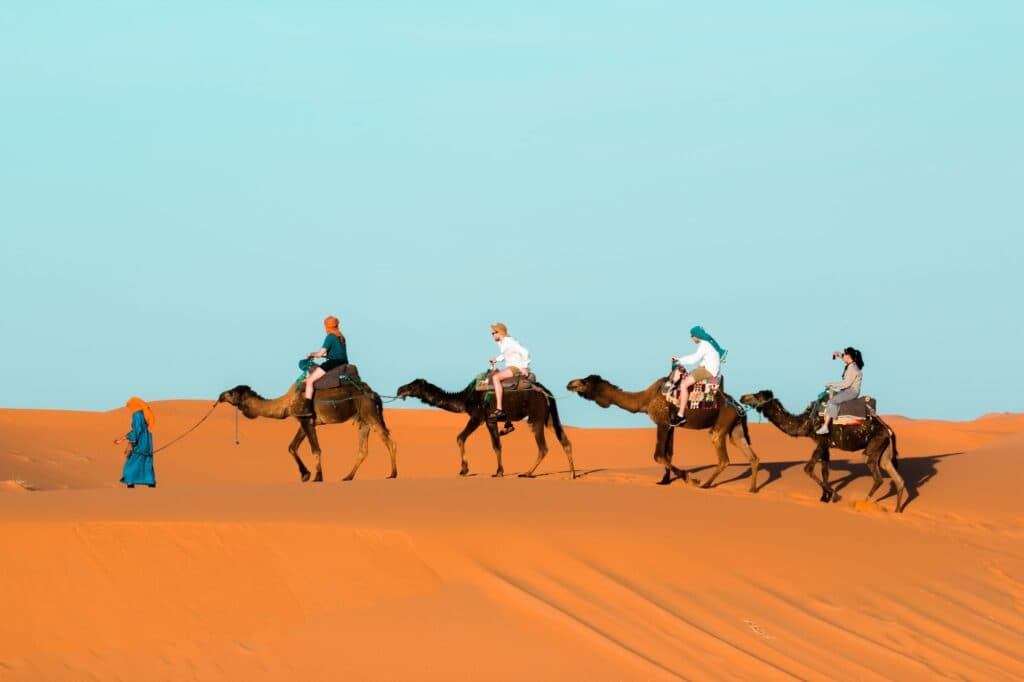
In the late afternoon you reach Merzouga at the edge of the Erg Chebbi dunes, which rise to around 150 metres. Swap the car for a camel and ride into the dunes for sunset (about 1–1.5 hours), then arrive at your desert camp for dinner, Berber drumming around the fire and a sky full of stars.
Overnight: desert camp in Erg Chebbi.
Day 7: Sahara Sunrise, Todra Gorge and Dades Valley
Driving time: about 5 hours.
Wake early to climb a dune for sunrise – one of the most memorable moments of any trip to Morocco. After breakfast, return to Merzouga and drive west via Rissani and Tinghir. Stop at the Todra Gorge, where limestone walls up to around 300 metres high narrow to a few metres apart; it is an easy and impressive walk along the riverbed. Continue along the “Road of a Thousand Kasbahs” to the Dades Valley, famous for its zigzag mountain road and rock formations.
Overnight: Dades Valley or Boumalne Dades.
Day 8: Rose Valley, Ouarzazate and Ait Ben Haddou
Driving time: about 3.5–4 hours.
Drive through Kelaat M'Gouna, the heart of the Valley of Roses (the rose harvest and festival usually take place in May), and the palm oasis of Skoura with the beautifully restored Kasbah Amridil. In Ouarzazate, nicknamed the gateway to the desert, you can visit the Kasbah Taourirt or one of the film studios that have hosted many international productions.
End the day at Ait Ben Haddou, a fortified ksar of earthen houses and a UNESCO World Heritage Site. Cross the river and climb to the granary at the top for sunset over the valley.
Overnight: Ait Ben Haddou (a guesthouse with a view of the ksar is unforgettable).
Day 9: Over the High Atlas to Marrakech
Driving time: about 4 hours.
The road crosses the Tizi n'Tichka pass at around 2,260 metres – the highest major paved pass in Morocco – with hairpin bends, Berber villages and huge views. Stop at a women's argan oil cooperative on the way down. Arrive in Marrakech by early afternoon, check into your riad and head to the Jemaa el-Fna square at dusk, when food stalls, musicians and storytellers bring it to life.
Overnight: Marrakech.
Day 10: Marrakech Highlights and Departure (or an Extra Night)
Spend the morning on Marrakech's highlights: the Koutoubia Mosque, the Bahia Palace, the Saadian Tombs, the Ben Youssef Madrasa and the souks for spices, lanterns, rugs and leather. In the afternoon, cool off at the Jardin Majorelle and the Yves Saint Laurent Museum next door (book tickets online in high season), or relax in a traditional hammam.
If your flight is the next day, enjoy a farewell dinner on a rooftop terrace overlooking the medina.
Optional Extension: Essaouira or the Atlas Mountains
If you can add an eleventh day, take a day trip to Essaouira (about 2.5–3 hours each way), a breezy, walled Atlantic port with a relaxed medina, blue fishing boats and grilled sardines straight from the harbour. Alternatively, spend a day in the Ourika Valley or Imlil at the foot of Mount Toubkal for easy hiking and lunch with a Berber family.
Variations: Luxury, Family and Adventure
Luxury 10 Days in Morocco
Keep the same route but upgrade every night: a palace-style riad in Fes, a luxury desert camp with private bathrooms and heated tents in winter, a kasbah hotel in Skoura instead of the Dades Valley, and a renowned hotel or riad with a spa in Marrakech. Add private guides in every city, a hot-air balloon flight over the Marrakech countryside at dawn and a cooking class. You might drop Casablanca altogether and fly into Fes to slow down the pace.
Family-Friendly Version
Children often find long drives harder than adults, so split Day 6 by sleeping one night in Midelt or the Ziz Valley, and cut Volubilis short if attention fades. Kids love camel rides, sandboarding on the dunes, the monkeys of the Azrou forest and the snake charmers and acrobats of Jemaa el-Fna (keep a respectful distance). Choose riads with pools, and request family tents in the desert camp. A private vehicle with child seats makes the whole trip far easier.
Adventure Version
Swap one Marrakech day for a guided ascent of Mount Toubkal (4,167 m, the highest peak in North Africa – typically a two-day trek from Imlil), add quad biking or a 4x4 excursion around Erg Chebbi, hike between the Todra and Dades gorges, or try canyoning in Akchour near Chefchaouen. In winter, the Atlas can be snowy, so check conditions before planning summit treks.
Where to Stay
Casablanca: a modern hotel near the Corniche or the city centre.
Chefchaouen: a small guesthouse inside or just above the medina.
Fes: a traditional riad or restored palace in Fes el-Bali for atmosphere.
Merzouga: a desert camp in the dunes – standard, comfort or luxury.
Dades Valley: a family-run hotel with gorge views.
Ait Ben Haddou: a kasbah-style guesthouse facing the ksar.
Marrakech: a riad in the medina, ideally within walking distance of Jemaa el-Fna.
How Much Do 10 Days in Morocco Cost?
Prices vary with season, group size and comfort level. The ranges below are approximate per person for 10 days, sharing a double room, excluding international flights:
Budget (about €700–1,100): simple riads and guesthouses, shared or small-group desert tour, trains and buses where possible.
Mid-range (about €1,200–2,000): charming riads, comfort desert camp, private driver shared between two or more travellers.
Luxury (about €2,500–5,000+): boutique riads and palace hotels, luxury camp, private guides in each city, exclusive experiences.
Useful benchmarks: a meal in a local restaurant is often around 60–120 MAD (about €6–12), a mint tea 10–20 MAD, a licensed half-day city guide roughly 300–500 MAD for a small group, and a dinner in an upscale riad 300–600 MAD or more. A private driver with vehicle for this route is usually the biggest single cost and is best shared among several travellers. The Moroccan dirham (MAD) is a closed currency, so exchange money on arrival or withdraw cash from ATMs; cards are accepted in hotels and larger shops but cash is king in the souks and the countryside.
Best Time to Spend 10 Days in Morocco
Spring (March–May): the best overall season – green valleys, roses in bloom, pleasant days in the desert.
Autumn (late September–November): warm, golden and ideal for the Sahara and the Atlas.
Winter (December–February): sunny days and fewer crowds, but very cold nights in the desert and possible snow on the Tizi n'Tichka pass. Pack warm layers.
Summer (June–August): very hot inland, with Marrakech and Fes often above 38 °C and the Sahara hotter still. Travel early in the day and favour the coast and mountains.
Also check the dates of Ramadan, which moves earlier by about 11 days each year. Travelling during Ramadan is perfectly possible and can be a fascinating experience, but some restaurants close during the day and opening hours change.
Getting Around: Private Driver, Self-Drive or Public Transport?
Private driver: the most popular choice for this itinerary. Your driver handles the long mountain roads, knows the best viewpoints and lunch stops, and gives you the freedom to stop wherever you like. It is especially worthwhile for families and small groups.
Self-drive: roads between cities are generally good, but driving in big-city traffic, mountain hairpins and unmarked rural roads demands confidence. Parking near medinas can be tricky, and police speed checks are frequent.
Trains and buses: the train network (including the high-speed Al Boraq line between Tangier, Rabat and Casablanca) works well in the north and to Marrakech, and long-distance coach companies serve Chefchaouen, Fes and Merzouga. However, reaching the desert and the southern kasbahs by public transport takes considerably longer and limits stops along the way.
What to Pack
Light, breathable clothing that covers shoulders and knees, plus a scarf (useful for mosques, sun and sand).
A warm fleece or jacket – desert nights are cool even in spring and autumn, and cold in winter.
Comfortable walking shoes for medinas and sandals for the dunes.
Sunglasses, a hat and high-factor sunscreen.
A small daypack, a reusable water bottle and a power bank.
A universal adapter (Morocco uses type C and E sockets, 220 V).
Basic medicines, hand sanitiser and tissues.
Cash in small notes for tips, tea and markets.
Cultural Tips for a Smooth Trip
Learn a few words: salam alaikum (hello), shukran (thank you), la, shukran (no, thank you). French is widely spoken.
Bargaining is expected in the souks: stay friendly, start low and walk away with a smile if the price is not right.
Always ask before photographing people, and expect some to decline or request a small tip.
Dress modestly, especially in rural areas and religious sites.
Drink bottled or filtered water, and enjoy the excellent tagines, couscous (traditionally on Fridays), harira soup and fresh orange juice.
Tipping is customary: round up in cafés, about 10% in restaurants, and a tip for drivers and guides at the end of the tour if you are happy with their service.
Frequently Asked Questions
Are 10 days enough to see Morocco?
Yes. Ten days is enough to see the highlights of Morocco – the imperial cities, Chefchaouen, the Sahara Desert, the Atlas Mountains and Marrakech – at a comfortable pace. You will not see everything (the far south and the Mediterranean coast need another trip), but you will get a rich and varied picture of the country.
Is it better to start in Casablanca or Marrakech?
Both work. Starting in Casablanca and ending in Marrakech (or the reverse) avoids backtracking. If flights into Marrakech are cheaper, simply start there and run the loop in the opposite direction, finishing with a train or transfer to Casablanca.
Is it safe to travel in Morocco for 10 days?
Morocco is generally considered a safe and welcoming destination for tourists, including families and solo travellers. Common sense applies: watch your belongings in crowded souks, use licensed guides and official taxis, and check your government's travel advice before you go.
How long is the drive from Fes to the Sahara Desert?
The drive from Fes to Merzouga covers around 470 km and takes about 7–8 hours with photo and lunch stops. Many travellers break it up with a night in Midelt or the Ziz Valley, especially with children.
Is one night in the Sahara enough?
One night gives you a sunset camel ride, a camp dinner, stars and sunrise – the essential experience. A second night lets you explore further by 4x4, visit nomad families and the Gnawa village of Khamlia, and simply enjoy the silence. If your schedule allows, two nights is a lovely upgrade.
Do I need a visa to visit Morocco?
Citizens of many countries, including the EU, UK, USA, Canada and Australia, can usually enter Morocco without a visa for stays of up to 90 days. Your passport should be valid for your whole stay. Rules can change, so always confirm with the official sources before travelling.
What is the best month for a 10-day Morocco itinerary?
April, May, October and early November are generally ideal, with warm days, cool nights and comfortable conditions for both the cities and the desert. March and late September are also excellent.
Plan Your 10 Days in Morocco with Travsus
A great Moroccan journey is all about rhythm: the right number of nights in each place, the right time of day for each sight and a driver who knows every viewpoint between Fes and Marrakech. At Travsus, we design private tours of Morocco departing from Marrakech, Fes, Casablanca and Tangier, with experienced local drivers and guides, comfortable air-conditioned vehicles and hand-picked riads and desert camps.
Every itinerary can be fully tailored – add a second night in the Sahara, slow down for children, upgrade to a luxury camp or include a Toubkal trek. Tell us your dates, your interests and your travel style, and we will build a 10-day Morocco itinerary that feels like it was made just for you. Contact Travsus through our website to start planning your Moroccan adventure.
- Morocco Itinerary
- 10 Days in Morocco
- Sahara Desert
- Morocco Travel Guide