
Merzouga
Merzouga Travel Guide: Erg Chebbi & Sahara Desert Tips
Plan your Merzouga trip: how to get there, Erg Chebbi camel treks, desert camps, best time to visit, prices, what to pack and expert Sahara tips.
TRAVSUS
· 13 min read

Few places on earth stop travellers in their tracks quite like Merzouga. One moment you are driving across a flat, stony plain in south-eastern Morocco; the next, a wall of apricot-coloured sand rises from the horizon, glowing pink at dawn and deep orange at dusk. These are the dunes of Erg Chebbi, the most famous sand sea in Morocco and, for many visitors, the highlight of their entire trip.
This Merzouga travel guide brings together everything you need to plan a smooth, memorable visit: where Merzouga is and how to get there, what to expect from a camel trek and a night in a desert camp, the best time of year to go, approximate prices, what to pack, and how to travel respectfully in a region that is home to Amazigh (Berber), Arab and Gnawa communities. Whether you are planning a quick escape from Marrakech or a slower journey through the south, you will find practical, honest advice here.
Merzouga at a Glance
Location: south-eastern Morocco, Errachidia Province, Drâa-Tafilalet region, close to the Algerian border.
Main attraction: Erg Chebbi, a sea of dunes roughly 22 km long, with the highest dunes rising around 150 metres.
Nearest airport: Errachidia (Moulay Ali Cherif), about 130 km or 2 hours away.
Driving time: about 9–10 hours from Marrakech and 7–8 hours from Fes, without long stops.
Best time to visit: October to April, with March–May and late September–November ideal for most travellers.
Ideal stay: at least one night in a desert camp; two nights if you want to explore the area properly.
Currency: Moroccan dirham (MAD), roughly 10–11 MAD to 1 euro.
Where Is Merzouga?
Merzouga is a small village at the western edge of Erg Chebbi, in the Tafilalet region of south-eastern Morocco. The nearest town of any size is Rissani, around 35 km to the north, a historic market town and the ancestral home of Morocco's ruling Alaouite dynasty.
Despite its fame, Merzouga remains a quiet place: a scattering of earth-coloured buildings, small guesthouses (often called kasbah hotels or auberges), a few cafés and shops, and the dunes looming just behind.
How to Get to Merzouga
Getting to Merzouga is part of the adventure. The roads are generally good and paved all the way to the village, but distances are long, so planning your route makes a big difference.
From Marrakech to Merzouga
The classic route crosses the High Atlas via the Tizi n'Tichka pass (around 2,260 metres), then continues through Ouarzazate, the Dades Valley and the Todra Gorge before reaching the desert. The total distance is about 560 km, which means 9–10 hours of pure driving. Because of this, most travellers split the journey over two days, typically stopping at Aït Benhaddou and spending a night in the Dades Valley or near Tinghir. A three-day Marrakech–Merzouga–Marrakech tour is the most popular format, while a three-day Marrakech to Fes tour via the desert is a great way to cross the country without backtracking.
From Fes to Merzouga
From Fes, the drive is shorter: about 470 km and 7–8 hours. The road climbs through the cedar forests of the Middle Atlas near Ifrane and Azrou, where you may spot Barbary macaques, crosses the high plateau around Midelt, and then descends through the spectacular Ziz Valley with its ribbon of palm groves. It is possible to drive it in one long day and still arrive in time for a sunset camel ride.
By Air: Errachidia and Ouarzazate
Errachidia's Moulay Ali Cherif Airport is the closest to Merzouga, about two hours away by road. Flights are limited and usually connect via Casablanca, so check schedules carefully. Ouarzazate Airport is another option, around 5–6 hours' drive from the dunes. There is no airport in Merzouga itself. If you fly in, arrange a transfer in advance, as public transport from the airports is scarce.
By Bus
Supratours and CTM run bus services to Merzouga from cities such as Marrakech and Fes, with daytime and overnight departures. Buses are an affordable option, but journeys are long (often 10–13 hours from Marrakech) and timetables change, so book ahead and confirm departure times.
Driving Yourself
Self-driving is perfectly feasible. Roads are paved, signposting is reasonable and fuel stations are found in the main towns. Avoid driving after dark where possible, watch for animals and pedestrians, respect speed limits (police checks are frequent) and never attempt to drive into the dunes in a rental car. Leave your car at your hotel or at your camp's meeting point and let local drivers or camel guides take you into the sand.
With a Private or Shared Tour
For most visitors, especially first-timers, an organised tour is the easiest way to reach Merzouga. Shared group tours are budget-friendly but follow a fixed schedule with many people. A private tour gives you your own driver-guide and vehicle, flexible timing, the freedom to stop for photos whenever you like, and the choice of accommodation and camp category that suits you.
Erg Chebbi: The Dunes Explained
An erg is a large area of wind-blown sand dunes. Erg Chebbi is one of Morocco's two great ergs (the other is Erg Chigaga, near M'Hamid), and it is by far the more accessible of the two. It stretches roughly 22 km from north to south and up to several kilometres from east to west, with dunes that shift slowly with the wind. The tallest reach around 150 metres above the surrounding plain, and climbing one at sunrise is an unforgettable workout.
The colour of the sand is what makes Erg Chebbi special. Rich in iron oxides, it shifts from pale gold at midday to coral, rose and burnt orange as the sun drops.
Camel Treks in Merzouga
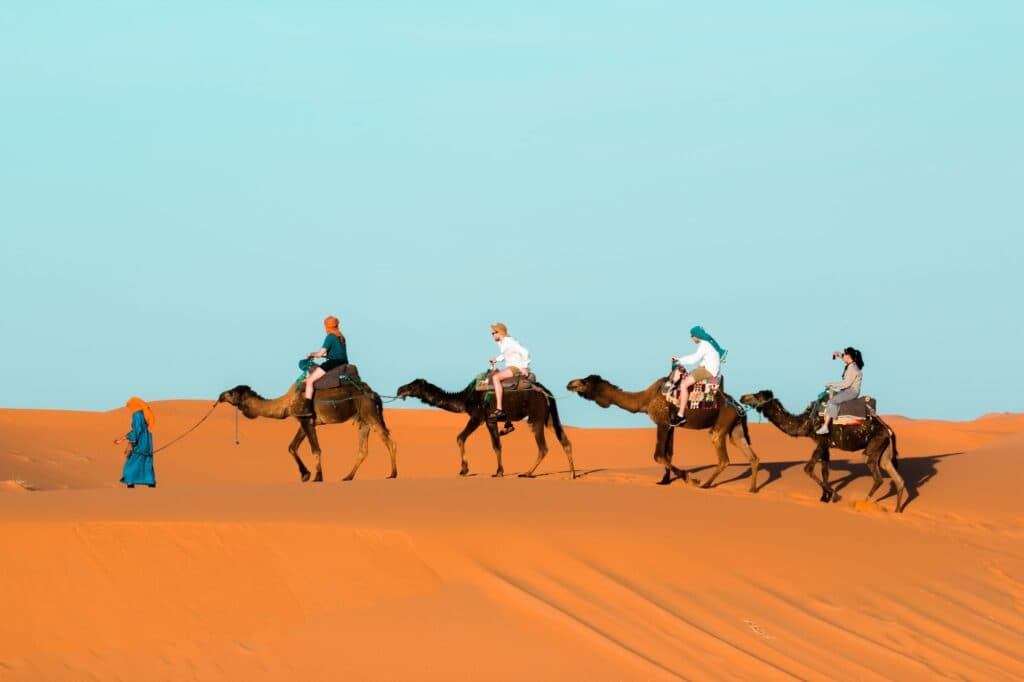
A camel ride across the dunes is the experience most people dream of. Strictly speaking, the animals used here are dromedaries (one-humped camels), and they are usually led on foot by a local guide, often from a family that has worked with camels for generations.
Sunset trek to camp: the most common option, lasting around 1–2 hours and ending at your desert camp in time to watch the sunset from a dune.
Sunrise return: the next morning you ride back to the village as the sky lightens, or return by 4x4 if you prefer.
Short rides: 30–60 minute rides are available if you are staying in a hotel at the edge of the dunes.
Riding a camel is easy but not always comfortable: the animal lurches forward and back when it stands up and sits down, so hold on tightly and lean back. Wear long trousers to avoid chafing. If you have back problems or simply prefer not to ride, you can walk alongside the caravan or reach the camp by 4x4.
Desert Camps in Merzouga: Standard vs Luxury
Spending a night in the Sahara is the heart of any Merzouga trip. Dozens of camps are scattered among the dunes, and they vary enormously in comfort and price.
Standard Desert Camps
Standard camps offer traditional tents made from woven fabric or wool, with simple beds and blankets. Bathrooms are often shared, and electricity may be limited to solar lighting. Dinner is usually a tagine or couscous served in a large communal tent, followed by drumming around the campfire. They are authentic, sociable and excellent value.
Luxury Desert Camps
Luxury camps take things to another level: spacious tents with proper beds, private en-suite bathrooms with hot showers and flush toilets, carpets and lanterns, often heating in winter and fans or air conditioning in summer. Meals are more elaborate, and some camps offer private dinners on the dunes and fire pits under the stars. They are ideal for honeymooners, families and anyone who wants comfort after a long drive.
How to Choose Your Camp
Ask a few key questions before booking. Is the bathroom private? Is there heating (essential from December to February)? How far is the camp from the nearest track? Is the camel ride included? Camps deep among the dunes feel more remote and peaceful, while those close to the edge are easier to reach and sometimes busier. For special occasions, a luxury tent is well worth the extra cost.
Sunrise and Sunset Over the Dunes
Light is everything in the desert. At sunset, the dunes cast long shadows and the sand seems to burn from within; at sunrise, the air is cool, the silence is complete and the first rays reveal every ripple in the sand. Most camps wake guests about 45 minutes before sunrise so they can climb a nearby dune. Bring a headlamp, take your time on the way up (climbing in soft sand is tiring) and keep your camera in a bag between shots to protect it from fine sand.
Top Things to Do in and Around Merzouga
Quad Biking and Dune Buggies
Quads (ATVs) and buggies are a thrilling way to explore the outer dunes. Sessions usually last from 30 minutes to 2 hours with a guide. Choose a reputable operator, wear the helmet provided and stay on authorised routes to protect the dunes and the peace of the camps.
Sandboarding
Many camps provide sandboards for free or for a small fee. Sand is slower than snow, so steeper dunes work best, and the walk back up is part of the fun. It suits teenagers and adults, and beginners pick it up quickly.
Khamlia and Gnawa Music
The village of Khamlia, around 7 km south of Merzouga, is home to a community of Gnawa musicians, descendants of people brought from sub-Saharan Africa centuries ago. Visitors are welcomed with mint tea and hypnotic performances of drums and the iron castanets called qraqeb. A tip or contribution for the musicians is customary and much appreciated.
Lake Dayet Srji
West of the dunes lies Dayet Srji, a seasonal lake that fills after good rains. When it holds water, it can attract migratory birds, sometimes including flamingos. In dry years it may be completely empty, so treat it as a bonus rather than a guaranteed sight.
Rissani Market
Rissani's traditional souk is one of the most authentic in southern Morocco and is liveliest on market days (traditionally Sunday, Tuesday and Thursday, but check locally). Look out for the donkey "parking", piles of local dates, spices and handmade goods. Nearby you can see the mausoleum of Moulay Ali Cherif, ancestor of the Alaouite dynasty, and the remains of Sijilmassa, once a great caravan city on the trans-Saharan trade routes.
Fossils and Minerals
The Erfoud and Rissani area is world-famous for fossils, especially trilobites, ammonites and orthoceras, many of them hundreds of millions of years old. Workshops show how the stones are cut and polished. Prices vary enormously, so take your time, compare, and be aware that some pieces are restored or reproductions.
Sand Baths
In the heat of summer, some locals and visitors practise a traditional therapy: being buried up to the neck in hot sand for a few minutes, believed to relieve rheumatism and joint pain. It should only be done under the supervision of someone experienced, followed by rest in the shade and plenty of water. Anyone with heart conditions, high blood pressure or other health concerns should consult a doctor first.
Stargazing
Far from city lights, the Sahara sky is astonishing. On clear, moonless nights you can see the Milky Way stretching from horizon to horizon. If stargazing is a priority, check the moon phase before you travel, and step away from the camp lights for the best view.
Merzouga Weather: Best Time to Visit
Spring (March to May)
Pleasant days of roughly 20–30°C and mild nights make spring one of the best seasons. Sandstorms driven by strong winds can occur, especially in March and April, so keep your plans flexible.
Summer (June to August)
This is the hottest period, with daytime temperatures often above 40°C. Activities are best kept to early morning and late afternoon. Camps with fans or air conditioning help, and summer is the traditional season for sand baths.
Autumn (September to November)
Autumn brings warm days, comfortable nights and generally stable weather, making it ideal for camel treks and photography.
Winter (December to February)
Days are sunny and mild (often 15–20°C), but nights can drop close to freezing. Choose a camp with heating or extra blankets and pack warm layers. Winter skies are often crystal clear, perfect for stargazing.
How Many Nights Should You Spend in Merzouga?
One night in a desert camp is the minimum and works well on a three-day tour from Marrakech or Fes. Two nights are ideal: one in a camp and one in a hotel at the edge of the dunes, or two nights in the desert, leaving time for a 4x4 tour, Khamlia, Rissani and an unhurried sunrise. Three nights or more suit photographers, families who want a slower pace and anyone planning a multi-day camel trek.
Merzouga Prices: Approximate Budget
Prices change with the season, group size and level of comfort, so treat these figures as rough guides only:
Standard desert camp with camel ride, dinner and breakfast: around €40–90 per person (about 450–1,000 MAD).
Luxury desert camp: around €120–350 or more per tent per night, depending on season and services.
Guesthouse or kasbah hotel near the dunes: from about €30 for a simple double room to €150 or more for upmarket hotels.
Quad bike: roughly €25–50 (250–500 MAD) per hour.
Dune buggy: often €80–150 per vehicle per hour.
Half-day 4x4 tour: around €60–120 per vehicle.
Bus from Marrakech or Fes to Merzouga: roughly €20–35 one way.
What to Pack for Merzouga
A small overnight bag for the camp (leave large suitcases in the vehicle or hotel).
Light, loose, long-sleeved clothing for the day and a warm fleece or jacket for the night.
A scarf or chech (the traditional desert turban) to protect you from sun and wind-blown sand.
Sunglasses, high-SPF sunscreen, lip balm and a hat.
Comfortable shoes or sandals; walking barefoot on sand is lovely, but it can be very hot at midday.
A headlamp or torch for the night.
A power bank, as charging in camps may be limited.
Wet wipes, hand sanitiser and any personal medication.
Zip bags or a dust cover to protect your phone and camera.
Cash in dirhams for tips, small purchases and markets.
Etiquette, Culture and Safety
The people of the Merzouga area are known for their hospitality, and a little respect goes a long way. Dress modestly in villages and markets, covering shoulders and knees. Always ask before photographing people, especially women and children, and accept a polite no. Accept tea when it is offered; it is a gesture of welcome. Tipping camel guides, drivers and camp staff is customary if you are happy with the service.
Merzouga is generally considered a safe destination. The main risks are natural: heat, dehydration and sunburn. Drink plenty of water, avoid long walks in the dunes at midday and never wander off into the erg alone at night, as dunes look very similar in the dark. The Algerian border is nearby and closed, so stay on known routes with local guides. Be wary of unofficial guides who approach you on the road offering deals, and book with reputable companies. Finally, protect the desert: take your rubbish with you and avoid driving outside authorised areas.
Merzouga FAQ
Is Merzouga worth visiting?
Absolutely. Erg Chebbi offers some of the most beautiful and accessible dunes in Morocco, and a night under the Saharan stars is a highlight for almost every traveller. The long drive is rewarded with spectacular landscapes along the way.
How far is Merzouga from Marrakech?
About 560 km, or 9–10 hours of driving. Most travellers break the journey with a night in the Dades Valley or the Todra area, which is why three-day tours are so popular.
Can you visit Merzouga on a day trip?
Not realistically from Marrakech or Fes, as the round trip would take most of two days on the road. From Errachidia or Erfoud a day visit is possible, but staying overnight is strongly recommended so you can enjoy sunset, sunrise and the stars.
Is Merzouga or Zagora better for the desert?
Zagora is closer to Marrakech but has only small dunes nearby. Merzouga's Erg Chebbi has much larger, more dramatic dunes. If you want the classic Sahara experience with towering sand dunes, Merzouga is the better choice.
Is it cold in the Sahara at night?
Yes, especially from November to February, when night temperatures can fall close to 0°C. Even in spring and autumn evenings are cool, so always pack a warm layer.
Is Merzouga safe for families and solo travellers?
Yes. Merzouga is welcoming to families, couples and solo travellers, including women travelling alone. Booking with a trusted local company and following your guide's advice makes the experience both safe and relaxed.
Discover Merzouga with Travsus Private Tours
At Travsus, the Sahara is more than a destination; it is at the heart of what we do. Our private tours to Merzouga depart from Marrakech, Fes, Casablanca and other Moroccan cities, with your own experienced driver-guide, a comfortable air-conditioned vehicle and a schedule built entirely around you. We help you choose between authentic standard camps and luxurious desert tents, plan the best route through the Atlas Mountains, the Dades Valley, the Todra Gorge or the Ziz Valley, and add experiences such as Gnawa music in Khamlia, a 4x4 tour of the erg or a morning in the Rissani souk.
Whether you dream of a romantic night under the stars, a family adventure or a photographer's journey across the dunes, Travsus will design a Merzouga tour that matches your pace and budget. Contact our team through the Travsus website and start planning your Sahara adventure today.
- Merzouga
- Erg Chebbi
- Sahara Desert
- Morocco Travel Guide