
Marrakech to Merzouga
Marrakech to Merzouga: Bus, Car, Flight or Tour Guide
Marrakech to Merzouga compared: distance, driving times, Supratours and CTM buses, self-drive, flights and private tours, plus the best stops and tips.
TRAVSUS
· 12 min read

Few journeys in Morocco are as dramatic as the trip from Marrakech to Merzouga. You cross the High Atlas over one of the highest paved passes in North Africa, drop into a land of kasbahs and palm groves, follow the "Road of a Thousand Kasbahs" past two famous gorges, and finally reach Erg Chebbi, where orange dunes rise out of the stony desert. It is one of the great road trips of the world, but it is also long, and how you travel makes a huge difference to how much you enjoy it.
This guide compares every realistic option: buses, self-drive, private drivers, grand taxis, flights, and group or private tours, with honest travel times, approximate costs, the best stops, and safety tips. Prices and timetables in Morocco change often, so treat all figures as approximate and confirm them before you travel.
Marrakech to Merzouga at a glance
Distance: roughly 550–560 km via Ouarzazate, Tinghir and Erfoud.
Driving time: about 9–10 hours without stops; 11–12 hours or more with meals, photos and fuel.
Main route: N9 over the Tizi n'Tichka pass (about 2,260 m) to Ouarzazate, then east through the Dades and Todra areas to Erfoud, Rissani and Merzouga.
Cheapest: public bus (Supratours or CTM), a very long day.
Most flexible: self-drive or a private driver.
Fastest on paper: a flight to Errachidia plus about 2 hours by road, though connections usually go via Casablanca.
Most popular: a 3-day tour with a night in the Dades Valley and a night in a desert camp.
Best seasons: spring and autumn; summer is very hot and winter nights are cold.
How far is Merzouga from Marrakech, really?
Merzouga is a small village on the western edge of Erg Chebbi, in the far east of Morocco near the Algerian border. The road distance from Marrakech is around 550–560 km, almost all on two-lane national roads rather than motorway. The first section climbs into the High Atlas through long series of hairpin bends, and many towns along the way have speed limits of 60 km/h or lower.
A driver who barely stops needs nine to ten hours. Add viewpoints, lunch, fuel and a visit to Ait Benhaddou or the Todra Gorge, and a one-day crossing easily becomes twelve hours. That is why most experienced travellers, and almost every tour, split the trip over at least two days.
The route in brief
From Marrakech the N9 climbs to Tizi n'Tichka, then descends past the turn-offs for Telouet and Ait Benhaddou to Ouarzazate, the "gateway to the desert". The N10 then runs east through the Skoura oasis, the Valley of Roses at Kelaat M'Gouna, Boumalne Dades and Tinghir. Beyond Tinejdad the road leads to Erfoud and Rissani, and the final stretch south brings you to Merzouga and the dunes.
Option 1: The bus from Marrakech to Merzouga
Two main coach companies serve tourists: Supratours, linked to the national rail operator ONCF, and CTM. Both run modern coaches with assigned seats and luggage holds, and tickets can usually be bought online, in their apps or at their stations.
Supratours
In recent years Supratours has run a service from Marrakech towards Merzouga along the classic route via Ouarzazate, Tinghir, Erfoud and Rissani. Departures are typically in the morning and the trip usually takes around 12–13 hours including stops. Fares have generally been a few hundred dirhams one way, making it by far the cheapest option. Book a few days ahead in busy periods.
CTM and overnight buses
CTM serves towns along the route such as Ouarzazate, Tinghir, Errachidia, Erfoud and Rissani, and some long-distance services run overnight. A night bus saves a hotel night, but you arrive tired and miss the scenery, which is half the point of the trip. If your bus stops in Rissani or Erfoud, continue by grand taxi or a transfer arranged by your desert hotel.
Pros and cons of the bus
Pros: very cheap, safe and stress-free; good for budget solo travellers.
Cons: a very long day, few departures, no sightseeing stops, and timetables that change.
Tip: bring water, snacks and a light jacket, as the air conditioning and the mountain pass can both be chilly.
Option 2: Self-drive from Marrakech to Merzouga
A rental car gives you total freedom to stop and sleep where you like. Agencies are plentiful at Marrakech Menara Airport and in the city. A small economy car is fine: the road is paved all the way to Merzouga, so you do not need a 4x4 unless you plan to go off-road, which in the dunes is best left to local drivers.
Road conditions
The N9 over the High Atlas is a good paved road, improved in many places, but it remains a mountain road with tight bends, slow lorries and occasional roadworks or rockfall. Between December and March snow can briefly close the Tichka pass, so check the weather first. East of Ouarzazate the road is mostly straight and easy, but watch for speed bumps in villages, donkeys, cyclists, children and goats. Avoid driving after dark.
Fuel
Fuel stations are frequent around Ouarzazate, Boumalne Dades, Tinghir, Erfoud and Rissani. Diesel is widely available and usually a little cheaper than petrol. Keep the tank above half full and carry cash in dirhams in case a card machine is down.
Police checks and speed limits
Police and Gendarmerie checkpoints are common at town entrances. Tourists are usually waved through, but slow down and stop if signalled. Radar checks are frequent. Roughly, limits are 120 km/h on motorways, 100 km/h on national roads and 60 km/h in towns, lower where signed. Stop completely at stop signs, wear seat belts and never use your phone while driving; fines are paid on the spot. Keep your licence, passport and rental papers in the car; an International Driving Permit is recommended for many nationalities.
Parking
In towns and at sights an informal attendant, the gardien, watches cars for a small tip. Most kasbah hotels and Merzouga hotels have secure parking, and if you sleep in a dune camp your car stays at the hotel where your camel trek or 4x4 transfer starts.
Is self-drive a good idea?
For confident drivers, yes. The downsides are fatigue, busy town centres, responsibility for the car, and the fact that the driver sees less of the scenery. You also miss the local knowledge of a good driver-guide.
Option 3: A private driver
A private driver combines the freedom of a car with the comfort of being driven. You choose the pace and the stops; the driver handles the road, checkpoints, parking and fuel. Many drivers are also knowledgeable guides who can explain Amazigh (Berber) culture, kasbah history and oasis life. Vehicles range from sedans to minivans and 4x4s.
The transfer can be done in one long day, but most travellers make it a two- or three-day private tour with a night in the Dades or Todra area and a night in a desert camp, returning to Marrakech or continuing to Fes. For three or more people, the cost per person can be close to that of car hire once fuel and hotels are included.
Option 4: Grand taxis
Grand taxis are shared long-distance taxis that leave when every seat is full. For the whole journey you would need several changes, typically Marrakech–Ouarzazate, Ouarzazate–Tinghir, Tinghir–Erfoud, and Erfoud or Rissani–Merzouga, waiting each time. It is cheap and authentic but slow and cramped. Grand taxis are best for the short final leg from Rissani or Erfoud; agree the price before you get in.
Option 5: Flying closer to the desert
Merzouga has no airport. The closest is Errachidia Moulay Ali Cherif Airport, about 130 km away, roughly two hours by road. Ouarzazate airport is around six hours from Merzouga, and Zagora is a gateway to the smaller Erg Chegaga area rather than Erg Chebbi.
Direct flights from Marrakech to these airports are rare or seasonal; most routes connect via Casablanca, so a "short" flight can take a full day. Flying makes sense if you arrive in Morocco via Casablanca or are very short of time. From Marrakech, the road is usually simpler, and the scenery is a highlight in itself.
Option 6: Group tours vs private tours
Shared group tours
Group tours use minibuses of up to about 17 passengers and follow a fixed plan, usually three days and two nights: Marrakech to the Dades Valley, then Dades to Merzouga via the Todra Gorge with a sunset camel ride and a camp night, then the long drive back. They are cheap and sociable, but stops are short, camps can be large and the last day is very long.
Private tours
A private tour gives you your own vehicle and driver, with an itinerary built around you: how long to spend in Ait Benhaddou, whether to hike in the gorges, which camp category to choose, and whether to finish in Marrakech or Fes. It costs more, but it is far more comfortable and flexible, ideal for families, couples, photographers and first-time visitors.
Comparison of all options
Bus (Supratours/CTM): about 12–13 hours; lowest cost; fair comfort; no sightseeing; best for budget solo travellers.
Self-drive: 9–10 hours of driving, best over two days; moderate cost; high flexibility; best for confident drivers.
Private driver or private tour: 2–4 days at your pace; higher cost shared by the group; very comfortable; best for families, couples and first-timers.
Shared group tour: usually 3 days; low to moderate cost; fixed schedule; best for sociable budget travellers.
Grand taxi: a long day with several changes; low cost; uncomfortable; best for short final legs.
Flight plus transfer: often a full day with connections; moderate to high cost; useful when time is very tight.
The best stops between Marrakech and Merzouga
Tizi n'Tichka pass
The highest point of the road, at about 2,260 m, offers sweeping views over the High Atlas, with Amazigh villages, fossil stalls and small cafés serving mint tea along the way.
Telouet
A detour from the pass leads to the Kasbah of Telouet, former stronghold of the Glaoui family, with remarkable painted ceilings and zellige tiles. The back road down the Ounila Valley to Ait Benhaddou is a scenic alternative to the main road.
Ait Benhaddou
This UNESCO-listed ksar of earthen houses climbing a hill above the Ounila river is one of Morocco's most photographed sights and a familiar film location. Walk up to the old granary at the top for the view.
Ouarzazate
Known for its film studios and the Kasbah of Taourirt, Ouarzazate is a handy stop for lunch, fuel or the night.
Skoura and the Valley of Roses
The Skoura oasis hides fine kasbahs among its palms, such as Amridil. Kelaat M'Gouna is famous for its Damask roses and holds a rose festival, usually in May; rose water and oils are sold all year.
Dades Gorges
From Boumalne Dades a road climbs into the gorges past rock formations nicknamed the "Monkey Fingers" to a famous series of hairpin bends. It is one of the best places to spend the night.
Todra Gorge
Just north of Tinghir, the Todra Gorge narrows between cliffs around 300 m high. Walk along the river at its narrowest point, then stroll through the palm groves of Tinghir.
Erfoud and Rissani
Erfoud is famous for fossils and its workshops of polished fossil marble. Rissani, historic heart of the Tafilalet and cradle of the Alaouite dynasty, has a lively traditional market. Nearby you can see khettaras, ancient underground irrigation channels.
Where to break the journey
Ait Benhaddou or Ouarzazate: about 4 hours from Marrakech; lovely at sunset, but it leaves a long second day.
The Dades Valley: roughly 6–7 hours from Marrakech, about halfway; the classic overnight stop.
Tinghir and the Todra Gorge: a little further, shortening the next day and letting you see the gorge in quiet morning light.
A comfortable plan is a 3-day route: Marrakech to the Dades Valley; Dades to Merzouga via the Todra Gorge with a sunset camel ride and a desert night; then back to Marrakech or on to Fes, about 7–8 hours from Merzouga via the Ziz Valley and the Middle Atlas. With four days or more you can add Telouet, a night in Skoura and a gorge hike.
Arriving in Merzouga
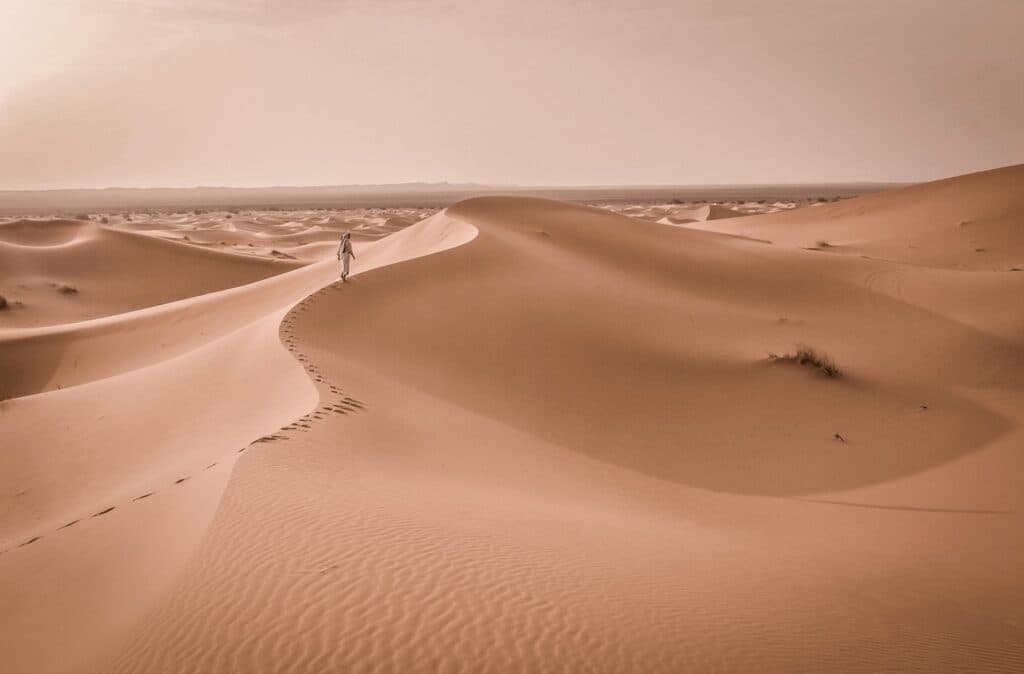
Merzouga sits at the foot of Erg Chebbi, whose highest dunes reach roughly 150 m. You can stay in a hotel on the edge of the dunes or ride a camel (or take a 4x4) into the sand to sleep in a camp, from simple tents to luxury camps with private bathrooms. Sunset, sunrise and the starry sky are unforgettable. Nearby you can visit nomad families, the seasonal lake of Dayet Srji and the Gnawa village of Khamlia.
Safety and practical tips
Start early, ideally by 7 or 8 a.m., to have daylight for the mountains.
Avoid night driving on rural roads.
Carry cash: there are ATMs in larger towns, but villages and some camps are cash only.
Prepare for motion sickness on the Tichka bends.
Pack layers: hot days and cold desert nights are normal, especially in winter.
Protect yourself from the sun with a hat, sunglasses, sunscreen and a scarf.
Beware of unofficial guides who flag down cars offering "better" camps.
Respect local customs: ask before photographing people and dress modestly in villages.
Get travel insurance covering road travel and activities such as camel rides.
Frequently asked questions
How long does it take to get from Marrakech to Merzouga?
The drive is about 550–560 km and takes around 9–10 hours without stops, or 11–12 hours with breaks. The bus usually takes 12–13 hours. Most travellers split the journey over two days.
Can you do Marrakech to Merzouga in one day?
Yes, but it is a very long day and you will see little on the way. If time is short, a private driver who handles the road while you rest is better than driving yourself.
Is there a direct bus from Marrakech to Merzouga?
Supratours has offered a direct service in recent years, while CTM serves nearby towns such as Rissani and Erfoud. Check current timetables and book ahead in busy seasons.
Is it safe to drive from Marrakech to Merzouga?
Generally, yes. The road is paved and well used. The main risks are mountain bends, fatigue, speeding and night driving, so take breaks and check the Tichka weather in winter.
Do I need a 4x4 to reach Merzouga?
No. A normal car reaches Merzouga on paved roads. A 4x4 is only needed for off-road tracks and dunes, best driven by a local expert.
Merzouga or Zagora from Marrakech?
Zagora is closer and suits a quick two-day trip, but its dunes are small. Merzouga takes longer to reach, yet Erg Chebbi offers the high, classic Sahara dunes. With three days or more, Merzouga is usually the better choice.
When is the best time to travel?
Spring and autumn are the most pleasant. Winter is clear but cold at night, with occasional snow on the pass. Summer is very hot, so plan activities for early morning and evening.
Travel from Marrakech to Merzouga with Travsus
At Travsus we believe the road to the Sahara should be a highlight of your trip, not an ordeal. Our private desert tours from Marrakech to Merzouga include your own vehicle and an experienced local driver who knows every bend of the Tichka pass, every kasbah worth seeing and the best places to eat. We tailor each itinerary to you, whether a classic three-day route through Ait Benhaddou, the Dades Valley and the Todra Gorge, a relaxed four-day journey, or a one-way trip finishing in Fes.
We select comfortable hotels and desert camps, from authentic to luxury, and arrange sunset camel rides, nights under the stars and visits to nomad families. Tell us your dates, group size and travel style, and we will design a private Marrakech to Merzouga tour that lets you enjoy every kilometre of this unforgettable journey.
- Marrakech to Merzouga
- Merzouga
- Morocco Transport
- Sahara Desert