
Morocco Itinerary
7 Day Morocco Itinerary: Imperial Cities & Sahara Desert
The perfect 7 day Morocco itinerary: Casablanca, Chefchaouen, Fes, a Sahara camp in Merzouga, Dades and Marrakech, with driving times, costs and tips.
TRAVSUS
· 14 min read

Seven days is the sweet spot for a first trip to Morocco. It is just enough time to see the country most travellers dream about: the blue lanes of Chefchaouen, the thousand-year-old medina of Fes, a night under the stars in the Sahara, the kasbah-lined valleys of the south and the irresistible energy of Marrakech.
This 7 day Morocco itinerary follows the route our team at Travsus drives week after week. It links the imperial cities and the Sahara Desert in one logical loop, from Casablanca on the Atlantic coast to Marrakech at the foot of the High Atlas, with realistic driving times, recommended overnight stops, approximate budgets and the practical advice we share with our own guests. Whether you travel with a private driver, by train or in a rental car, you will find everything you need to plan your week below.
Your 7-Day Morocco Itinerary at a Glance
Route: Casablanca – Rabat – Chefchaouen – Fes – Merzouga (Sahara) – Todra & Dades – Ait Ben Haddou – Marrakech
Total distance: roughly 1,600 to 1,700 km
Longest driving day: Fes to Merzouga, about 8 to 9 hours including stops
Best time to go: March to May and late September to November
Highlights: Hassan II Mosque, the blue city of Chefchaouen, the Fes medina, a camel ride and desert camp in Erg Chebbi, Todra Gorge, the UNESCO-listed ksar of Ait Ben Haddou and Jemaa el-Fnaa square
Best way to travel: a private driver for the whole loop, or trains in the north combined with a private desert tour
Flights: arrive in Casablanca (CMN) and leave from Marrakech (RAK), or simply reverse the route
Why This Route Works
Morocco's most famous sights sit on a natural circuit. The imperial cities of Rabat, Fes, Meknes and Marrakech are spread across the north and centre of the country, while the great dunes of Erg Chebbi lie on the far side of the Atlas Mountains, close to the Algerian border. If you try to visit them as separate trips from one base, you end up retracing the same roads. By flying into Casablanca and out of Marrakech (an "open-jaw" ticket that usually costs little or nothing extra), you travel in a single loop and never drive the same stretch twice.
Day 1: Casablanca and Rabat to Chefchaouen
Most long-haul flights land at Mohammed V International Airport, about 30 minutes from central Casablanca. Begin with the Hassan II Mosque, one of the largest mosques in the world, built partly over the Atlantic Ocean and crowned by a minaret more than 200 metres tall. It is one of the very few mosques in Morocco that non-Muslim visitors can enter, on guided tours held outside prayer times. Take a short walk along the Corniche before heading north.
About an hour and a quarter up the coast lies Rabat, the calm and elegant capital. Stop at the unfinished Hassan Tower and the richly decorated Mausoleum of Mohammed V, then wander through the whitewashed lanes of the Kasbah of the Udayas, which overlooks the mouth of the Bou Regreg river. A mint tea in the Andalusian garden is the perfect pause before the afternoon drive through rolling farmland and the foothills of the Rif Mountains to Chefchaouen.
Driving time: about 5 to 5.5 hours in total (roughly 340 km)
Overnight: a guesthouse or small riad in Chefchaouen
Day 2: Chefchaouen to Fes
Wake up early, when the blue-washed medina of Chefchaouen is at its most peaceful. The town was founded in the fifteenth century and its famous shades of blue cover walls, doors and staircases. Wander up to Ras El Maa, the spring where locals still wash clothes, browse the small shops selling woven blankets and goat cheese, and climb to the little Spanish Mosque on the hillside for a panoramic view over the town and the valley.
After lunch, drive south through olive groves and green hills to Fes. Arriving in the late afternoon gives you time to check into your riad, enjoy a rooftop view over the medina and try a first Fassi dinner. Fes cuisine is considered among the finest in Morocco, so do not miss pastilla, the sweet and savoury pie traditionally made with pigeon or chicken.
Driving time: about 3.5 to 4 hours (roughly 200 km)
Overnight: a traditional riad inside or next to the Fes medina
Day 3: A Full Day in Fes, Morocco's Spiritual Capital
Fes el-Bali, the old walled city, is a UNESCO World Heritage Site and one of the largest car-free urban areas in the world. Its maze of more than nine thousand alleys can be overwhelming, which is why we strongly recommend a licensed local guide for at least half a day.
Essential stops include the Bab Bou Jeloud gate with its blue and green tiles, the beautifully carved Bou Inania and Al-Attarine madrasas, the Nejjarine fountain and woodwork museum, and the doorways of the Al Quaraouiyine mosque and university, founded in the ninth century and often described as one of the oldest continuously operating universities in the world. Non-Muslims cannot enter the prayer hall, but you can glimpse the courtyard from the entrance.
No visit is complete without the Chouara Tannery, where leather has been dyed in stone vats for centuries. In the afternoon, visit the golden doors of the Royal Palace in Fes el-Jdid, walk through the old Jewish quarter (Mellah) and finish at the Merenid Tombs for sunset over the medina.
Driving time: none, apart from short transfers
Overnight: Fes
Option: if you prefer Roman ruins to a second half-day in the medina, take a half-day trip to Volubilis and the imperial city of Meknes.
Day 4: Fes to Merzouga and the Sahara Desert
Today is the longest drive of the trip, but also one of the most varied. Leave Fes after breakfast and climb into the Middle Atlas to Ifrane, a tidy mountain town with sloping roofs that locals like to call "the Switzerland of Morocco". Nearby, the cedar forests around Azrou are home to troops of Barbary macaques. Continue over high plateaus to Midelt, a good lunch stop known for its apples, then descend through the dramatic Ziz Gorges and along the palm-filled Ziz Valley towards Erfoud and Rissani.
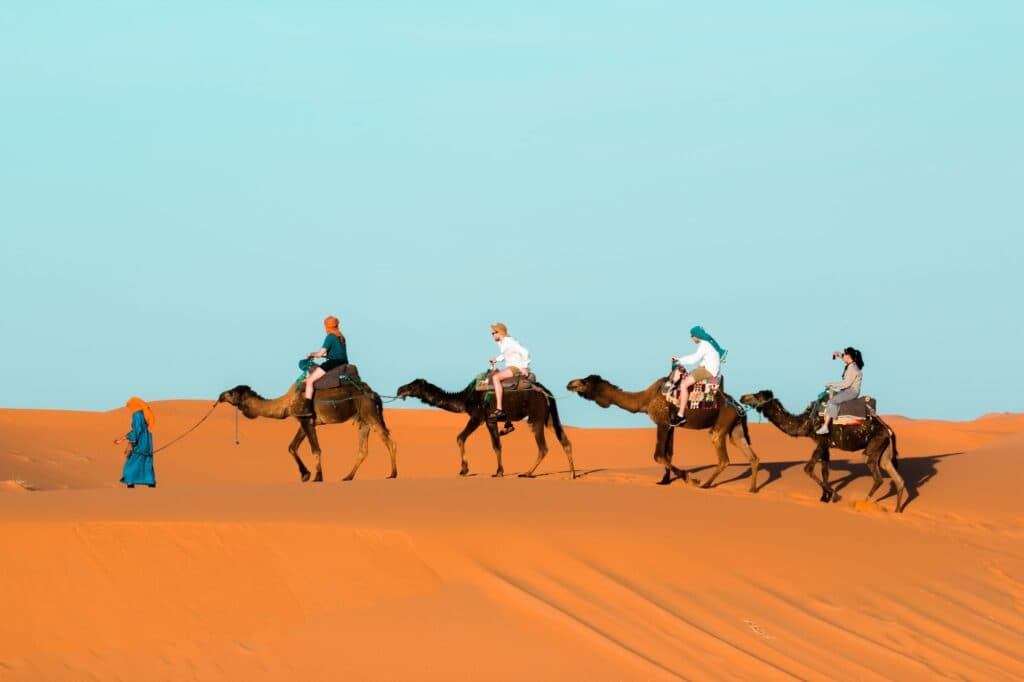
In the late afternoon the first orange dunes of Erg Chebbi appear on the horizon, some rising well over 100 metres. In Merzouga you leave the vehicle, mount a camel and ride into the dunes for about an hour to an hour and a half, timing your arrival with the sunset. Dinner at camp is usually a tagine followed by Berber drumming around the fire, and on a clear night the sky is filled with more stars than most city dwellers have ever seen.
Driving time: about 8 to 9 hours with stops (roughly 470 km)
Overnight: a desert camp in Erg Chebbi, either a standard Berber camp or a luxury camp with private bathrooms
Tip: pack a small overnight bag for the camp; your main luggage can stay safely in the vehicle or at the hotel.
Day 5: Merzouga to the Todra Gorge and Dades Valley
Set your alarm for sunrise. Climbing a dune at dawn and watching the light change the sand from grey to gold is, for many travellers, the highlight of the whole trip. After breakfast, ride or walk back to Merzouga for a shower.
Drive west along the "Road of a Thousand Kasbahs", passing desert villages and the underground irrigation channels known as khettaras. At Tinghir, turn into the Todra Gorge, where sheer limestone walls rise up to around 300 metres above a narrow river, a favourite spot for climbers. Continue to the Dades Valley, where the road winds between strangely eroded rock formations, sometimes called the "monkey fingers", and tight hairpin bends with spectacular viewpoints.
Driving time: about 5 to 6 hours with stops (roughly 300 km)
Overnight: a kasbah-style hotel in the Dades Gorge
Tip: nights in the valley can be cool even in spring, so keep a warm layer handy.
Day 6: Ait Ben Haddou and the High Atlas to Marrakech
Follow the Dades River to Kalaat M'Gouna, the heart of the Valley of Roses, where Damask roses are harvested in spring and celebrated each May at a lively rose festival. Pass the vast palm grove of Skoura and reach Ouarzazate, the "door of the desert", famous for its film studios and the Taourirt Kasbah.
Just beyond lies Ait Ben Haddou, a fortified village of earthen houses climbing a hillside above a riverbed. This UNESCO World Heritage Site was once an important stop on the caravan route between the Sahara and Marrakech, and has appeared in many films and television series.
The afternoon brings the most scenic road in Morocco: the Tizi n'Tichka pass, which crosses the High Atlas at about 2,260 metres. Expect switchbacks, red and green mountainsides, Amazigh (Berber) villages clinging to the slopes and stalls selling minerals and argan products. You arrive in Marrakech in the early evening.
Driving time: about 6 to 7 hours with stops (roughly 320 km)
Overnight: a riad in the Marrakech medina or a hotel in Gueliz or Hivernage
Day 7: Discover Marrakech
Spend your final day exploring the Red City. Start at the Koutoubia Mosque, whose twelfth-century minaret is the city's landmark. Then visit the Bahia Palace with its painted cedar ceilings and courtyards, the Saadian Tombs, and the beautifully restored Ben Youssef Madrasa. In the afternoon, find calm in the cobalt-blue Jardin Majorelle (book a time slot in advance) before losing yourself in the souks, where you can shop for lanterns, rugs, leather and spices.
As the sun sets, head to Jemaa el-Fnaa, the great square where storytellers, musicians and food stalls create one of the world's great street spectacles.
Alternative Versions of This Itinerary
Starting and Ending in Marrakech
If you find a cheaper return flight to Marrakech, turn the route into a loop: Day 1 in Marrakech, Day 2 over the Atlas to Ait Ben Haddou and the Dades Valley, Day 3 through the Todra Gorge to the desert camp in Merzouga, Day 4 north to Fes, Day 5 in Fes, Day 6 to Chefchaouen and Day 7 back to Marrakech, either by private car via Rabat and Casablanca or by train from Fes.
Adding Essaouira
The relaxed, windswept port of Essaouira is about 2.5 to 3 hours from Marrakech (roughly 190 km). Its fortified ramparts, blue fishing boats, art galleries and fresh grilled seafood make it the perfect contrast to the busy medinas. To include it, either replace your full day in Marrakech with a day trip, or better, add an eighth day and spend a night by the sea.
Where to Stay Along the Route
Chefchaouen: small guesthouses inside the medina, many with rooftop terraces over the blue town.
Fes: a riad in Fes el-Bali, ideally one reached easily from a gate such as Bab Bou Jeloud, so your luggage does not travel far by handcart.
Merzouga: standard desert camps with shared facilities, or luxury camps with private tents, en-suite bathrooms and proper beds.
Dades Valley: family-run kasbah hotels with views over the gorge.
Marrakech: a riad in the medina for atmosphere, or a hotel in Gueliz or Hivernage for more space and a pool.
How Much Does a 7-Day Morocco Trip Cost?
Prices vary with the season, your comfort level and the size of your group, so the figures below are approximate ranges per person, excluding international flights (1 EUR is roughly 10 to 11 MAD):
Budget: about €500 to €800, using simple guesthouses, trains, shared tours and local restaurants.
Mid-range: about €900 to €1,600, with comfortable riads, a private driver and a standard or semi-luxury desert camp.
Luxury: €2,000 and upwards, with boutique riads, a luxury desert camp and private guides in every city.
Some typical costs to help you plan: a mid-range riad double room costs roughly €60 to €150 per night (about 650 to 1,600 MAD); a desert camp night including camel ride, dinner and breakfast ranges from about €40 to €80 per person for a standard camp and €120 or more for a luxury camp; a tagine in a local restaurant costs about 60 to 120 MAD; and most monument entrance fees are between 30 and 100 MAD, with the Jardin Majorelle among the more expensive.
Best Time for a 7 Day Morocco Itinerary
Spring (March to May) and autumn (late September to November) are the best seasons. Days are warm and sunny, the desert is pleasant and the Atlas valleys are green or golden. Summer (June to August) is possible, but temperatures in Fes, Marrakech and especially the Sahara regularly exceed 40°C, so plan early starts and long midday breaks. Winter (December to February) brings bright days, quieter sights and lower prices, but desert nights can drop close to freezing and snow sometimes closes the Tizi n'Tichka pass or the roads around Ifrane for a few hours.
Getting Around: Private Driver, Train or Self-Drive?
Private Driver
For a 7-day loop that includes the Sahara, a private driver is the most comfortable and efficient choice. You travel in an air-conditioned vehicle at your own pace, stop wherever you like for photos, and benefit from a driver who knows the roads, the best lunch stops and the local customs. It removes the stress of navigation, parking and night driving, and costs are shared when you travel as a family or group.
Train
Morocco's ONCF rail network is modern and affordable in the north. Trains link Casablanca, Rabat, Meknes, Fes and Marrakech, and the high-speed Al Boraq connects Casablanca, Rabat and Tangier. However, there is no railway to Chefchaouen, the Sahara or the southern valleys. A practical compromise is to use the train between Casablanca, Rabat and Fes, then join a private desert tour from Fes ending in Marrakech.
Self-Drive
Renting a car is possible and the main roads are generally in good condition. Be prepared for long distances, police speed checks, slow trucks on mountain passes, livestock on rural roads and difficult parking near the medinas. Avoid driving after dark outside the cities.
What to Pack for Morocco
Light, breathable clothing that covers shoulders and knees, plus a scarf (useful for sun, dust and mosque visits)
A warm fleece or jacket for desert nights and mountain passes, even in spring and autumn
Comfortable walking shoes for the medinas and sandals for the dunes
Sunglasses, a hat and high-factor sunscreen
A small daypack and an overnight bag for the desert camp
A universal travel adapter (Morocco uses type C and E sockets, 220 V)
Some cash in small notes; cards are accepted in many hotels but not in most souks
Cultural Tips for a Smooth Trip
Dress modestly, especially in smaller towns and religious sites; this is a sign of respect and makes you feel more comfortable.
Greet people with "Salam alaikum" and a smile; a few words of French or Darija go a long way.
Ask before photographing people, and expect that some performers in Jemaa el-Fnaa will ask for a tip.
Bargaining is normal in the souks. Stay friendly, take your time and only start negotiating if you really want the item.
Politely decline unofficial guides and anyone who tells you a street is "closed".
Frequently Asked Questions
Is 7 days enough for Morocco?
Seven days is enough to see the highlights of Morocco: two imperial cities, the blue town of Chefchaouen, a night in the Sahara and the kasbahs of the south. You will not see everything, but a well-planned route like this one gives a rich, varied first impression of the country without feeling rushed.
Should I start my Morocco itinerary in Casablanca or Marrakech?
Starting in Casablanca and ending in Marrakech (or the reverse) is the most efficient option because you never retrace your steps. If return flights to Marrakech are much cheaper, a loop from Marrakech works too, but expect one longer driving day at the end.
How many hours is the drive from Fes to Merzouga?
The drive is about 470 km and takes roughly 7 hours of pure driving, or 8 to 9 hours with stops in Ifrane, Azrou, Midelt and the Ziz Valley. Leaving Fes by 8 am usually gets you to Merzouga in time for a sunset camel ride.
Is it safe to travel around Morocco for a week?
Morocco is a popular and generally welcoming destination, and millions of visitors travel there every year without problems. As anywhere, watch your belongings in crowded places, use licensed guides and taxis, and check your government's current travel advice before you go.
How much does a 7 day Morocco itinerary cost?
Excluding flights, most travellers spend roughly €500 to €800 per person on a budget trip, €900 to €1,600 for a mid-range private tour and €2,000 or more for luxury travel. The biggest variables are accommodation, the type of desert camp and whether you travel privately.
Travel This Route with Travsus
At Travsus, we are a Morocco-based team specialising in private tours from Marrakech, Fes, Casablanca and Tangier to the Sahara Desert, the Atlas Mountains and the imperial cities. Our 7-day itinerary can be adapted to your dates, interests and budget: start in any city, add Essaouira or Volubilis, choose a standard or luxury desert camp, or slow down with an extra night in Fes or Marrakech.
You will travel in a comfortable private vehicle with an experienced, English-speaking local driver, and we can arrange licensed guides, carefully selected riads and camps that we know personally. Get in touch through the Travsus website to tell us about your plans, and we will design a tailor-made Morocco itinerary that lets you enjoy every moment, from the first mint tea to the last sunset over the dunes.
- Morocco Itinerary
- 7 Days in Morocco
- Sahara Desert
- Imperial Cities