
Morocco Itinerary
14 Days in Morocco: The Ultimate 2-Week Itinerary
Plan 2 weeks in Morocco with this day-by-day itinerary: Casablanca, Chefchaouen, Fes, the Sahara, Atlas, Marrakech & Essaouira, plus budget and tips.
TRAVSUS
· 13 min read

Two weeks is the sweet spot for a first trip to Morocco. With 14 days in Morocco you can stand inside one of the largest mosques in the world in Casablanca, wander the blue lanes of Chefchaouen, get gloriously lost in the medieval medina of Fes, sleep under the stars in the Sahara, drive through palm-filled gorges and mud-brick kasbahs, hike in the High Atlas and finish with grilled fish on the Atlantic in Essaouira.
2 Weeks in Morocco at a Glance
Route: Casablanca – Rabat – Chefchaouen – Volubilis – Meknes – Fes – Merzouga (Sahara) – Todra Gorge – Dades Valley – Ouarzazate – Ait Ben Haddou – Imlil (High Atlas) – Marrakech – Essaouira
Start / end: arrive in Casablanca, depart from Marrakech (an open-jaw flight saves you a full day of backtracking)
Total driving: roughly 2,300–2,500 km, never more than one very long day in a row
Nights: 1 Casablanca, 2 Chefchaouen, 2 Fes, 2 Sahara, 1 Dades, 1 Ait Ben Haddou, 1 Imlil, 2 Marrakech, 1 Essaouira, plus a final morning drive
Best for: first-time visitors, couples, families and small groups who want culture, landscapes and adventure in one trip
Best seasons: March to May and September to November
Ideal transport: a private driver with a comfortable 4x4 or minivan
Day-by-Day 14-Day Morocco Itinerary
Day 1: Arrive in Casablanca – Hassan II Mosque & the Corniche
Land at Mohammed V International Airport, about 40–50 minutes from the city centre. After checking in, head straight to the Hassan II Mosque, built on a platform over the Atlantic and topped by a minaret around 210 metres high. It is one of the very few mosques in Morocco open to non-Muslim visitors, on guided tours outside prayer times, and the craftsmanship inside (carved cedar, zellige tilework, hand-cut marble) is a perfect introduction to Moroccan artistry.
In the late afternoon, walk along the Corniche in Ain Diab, then stroll past the Art Deco and neo-Moorish facades of the city centre around Boulevard Mohammed V and the Habous quarter. Casablanca is a modern business city rather than a postcard town, so one night is plenty.
Overnight: Casablanca.
Day 2: Rabat, the Capital, then on to Chefchaouen
Driving: Casablanca to Rabat about 1h15; Rabat to Chefchaouen about 3h30–4h.
Rabat is calm, green and surprisingly elegant. In a morning you can see the Hassan Tower and the Mausoleum of Mohammed V with its guards in ceremonial uniform, then wander the whitewashed lanes of the Kasbah of the Udayas, which overlooks the mouth of the Bou Regreg river.
After lunch, drive north through farmland and into the green foothills of the Rif Mountains to reach Chefchaouen by late afternoon, just as the blue walls start to glow.
Overnight: Chefchaouen.
Day 3: Chefchaouen, the Blue Pearl
Give yourself a full, unhurried day here. Mornings are the best time for photographs, before the day-trippers arrive. Explore the medina's indigo alleys, the central square Plaza Uta el-Hammam and the red-walled kasbah, then follow the stream up to Ras El Ma, where locals still wash carpets in the spring water.
For a bit of nature, take a 45-minute drive to Akchour in Talassemtane National Park for a walk to waterfalls and the natural rock arch known as God's Bridge (allow half a day). End with the 30-minute walk up to the Spanish Mosque for sunset over the town.
Overnight: Chefchaouen.
Day 4: Volubilis & Meknes to Fes
Driving: Chefchaouen to Volubilis about 3h30; Volubilis to Meknes about 40 minutes; Meknes to Fes about 1h.
The Roman city of Volubilis, a UNESCO World Heritage Site, is the best-preserved ancient site in Morocco. Its mosaics, triumphal arch and basilica columns stand in open countryside with olive groves all around. Nearby, the holy town of Moulay Idriss Zerhoun clings to two hills and makes a lovely viewpoint.
Continue to Meknes, the imperial city of Sultan Moulay Ismail. See the monumental Bab Mansour gate, the vast royal granaries and stables (Heri es-Souani) and the square of El Hedim, then drive the final hour to Fes.
Overnight: Fes, ideally in a riad inside the medina.
Day 5: Fes – Inside the World's Great Living Medina
Fes el-Bali is a labyrinth of around 9,000 lanes where donkeys still carry goods and craftsmen work exactly as their grandparents did. This is the one place on the trip where a licensed local guide makes a huge difference, both to navigate and to unlock the stories behind closed doors.
Bou Inania Madrasa and Al-Attarine Madrasa, masterpieces of Marinid carved stucco and cedar
The exterior and courtyards visible from the gates of the Al-Qarawiyyin mosque and university, founded in the 9th century
The Chouara tannery, best seen in the morning from a leather shop terrace
The Nejjarine fountain and woodwork museum, the coppersmiths' square of Seffarine
The golden doors of the Royal Palace and the old Jewish quarter, the Mellah
Sunset from the Merinid Tombs above the city
Tip: keep the afternoon free for a hammam or a cooking class. Fes cuisine is considered among the most refined in the country.
Overnight: Fes.
Day 6: Fes to Merzouga via the Middle Atlas – Camel Trek into the Dunes
Driving: about 470 km, 7–8 hours with stops. This is the longest day of the trip, but also one of the most varied.
Leave early and climb into the Middle Atlas. Stop at Ifrane, nicknamed the Switzerland of Morocco for its alpine-style houses, and at the Azrou cedar forest, where wild Barbary macaques live among the trees. Continue through Midelt and over the Tizi n'Talghamt pass, then down into the spectacular Ziz Valley, a ribbon of palm groves in a canyon of rock.
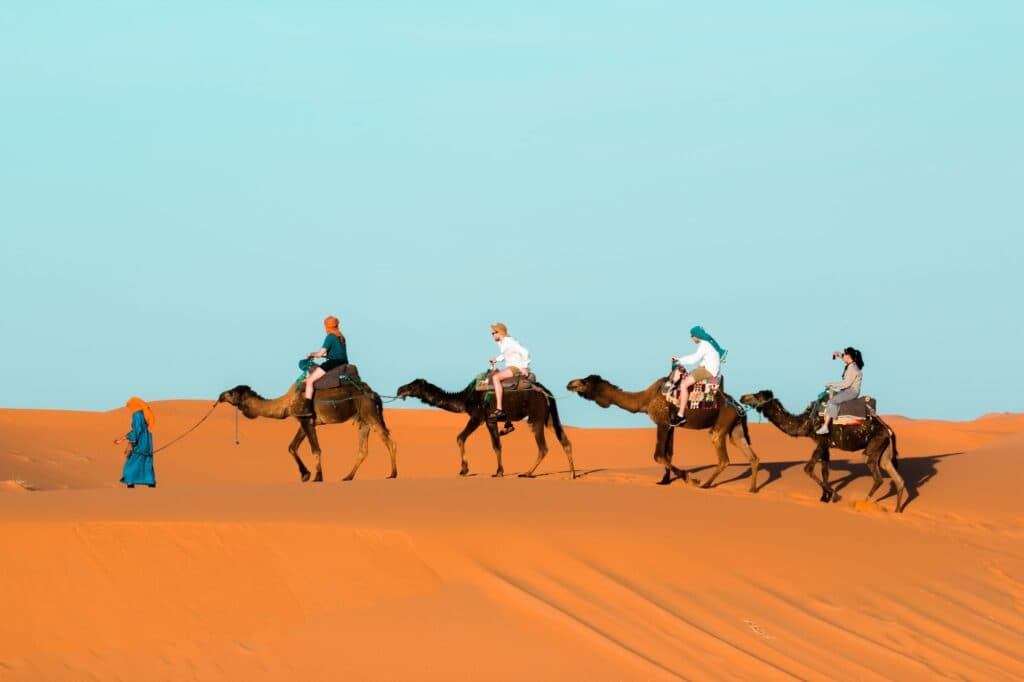
Past Erfoud, the golden dunes of Erg Chebbi rise from the plain, some reaching around 150 metres. In the late afternoon you swap the car for a camel and ride into the dunes for sunset, arriving at your desert camp for dinner, drumming around the fire and a sky crowded with stars.
Overnight: desert camp in Erg Chebbi.
Day 7: A Full Day in the Sahara
Many itineraries rush in and out of the desert in one night. We recommend two. Wake up early for sunrise from the top of a dune, then spend the day at desert pace:
A 4x4 tour around Erg Chebbi, visiting nomad families and old mining areas
Khamlia, a village known for Gnawa music, with roots in sub-Saharan Africa
Sandboarding, quad biking or simply a long lunch in the shade
The seasonal lake of Dayet Srji, where flamingos sometimes appear after rainy winters
Overnight: desert camp or a kasbah hotel at the edge of the dunes.
Day 8: Rissani, Todra Gorge & the Dades Valley
Driving: Merzouga to Todra Gorge about 3h30; Todra to Dades about 1h30.
Pass through Rissani, a historic caravan town with a lively market (best on Sundays, Tuesdays and Thursdays), then head west along the road of a thousand kasbahs. At Todra Gorge, sheer limestone walls of around 300 metres close in to just a few metres apart; walk the narrowest section along the river and watch climbers on the rock faces.
Continue to the Dades Valley, with its red rock formations nicknamed the "monkey fingers" and the famous hairpin road climbing out of the gorge.
Overnight: Dades Valley.
Day 9: Valley of Roses, Skoura, Ouarzazate & Ait Ben Haddou
Driving: about 3h30–4h in total.
Drive through Kelaat M'Gouna, the heart of the Valley of Roses, where Damask roses are harvested each spring and a rose festival takes place, usually in May. In the palm oasis of Skoura, visit a restored kasbah such as Kasbah Amridil. In Ouarzazate, the gateway to the desert, see the Taourirt Kasbah or the film studios that have hosted countless desert epics.
Arrive at Ait Ben Haddou in the afternoon. This fortified village of earthen houses is a UNESCO site and a favourite location for film and television productions. Cross the river and climb to the granary at the top for golden-hour views.
Overnight: Ait Ben Haddou.
Day 10: Over the Tizi n'Tichka Pass to Imlil in the High Atlas
Driving: about 4h30 with photo stops.
The road over the Tizi n'Tichka pass (around 2,260 metres) is one of the most scenic drives in North Africa, with Amazigh (Berber) villages clinging to terraced slopes. A detour via Telouet and its faded Glaoui kasbah is worthwhile if you start early. Drop down towards the Haouz plain, then climb again via Asni to Imlil, a mountain village at the foot of Jebel Toubkal, North Africa's highest peak at 4,167 metres.
Overnight: a mountain guesthouse in Imlil.
Day 11: Hike in the High Atlas, then Marrakech
Driving: Imlil to Marrakech about 1h30.
Spend the morning walking with a local mountain guide. A classic loop goes through walnut groves to the village of Aremd and up to the shrine of Sidi Chamharouch, or over the Tizi n'Mzik pass for big views. Have lunch with mint tea in a family home, then drive down to Marrakech in the afternoon.
Overnight: Marrakech.
Day 12: Marrakech, the Red City
Begin early to beat the heat and the crowds. A full day in Marrakech could include:
Jardin Majorelle and the neighbouring Yves Saint Laurent Museum (book ahead)
The Koutoubia Mosque minaret, the symbol of the city
The Bahia Palace and the Saadian Tombs
The Ben Youssef Madrasa, one of the most beautiful buildings in Morocco
The souks: spices, lanterns, leather, carpets and the dyers' souk
Jemaa el-Fna at dusk, when food stalls, storytellers and musicians fill the square
Overnight: Marrakech.
Day 13: Marrakech to Essaouira on the Atlantic
Driving: about 2h30–3h.
The road west crosses the argan country, where you may see goats climbing argan trees and can stop at a women's argan oil cooperative. Essaouira, the old Mogador, is a breezy, laid-back port town with a UNESCO-listed medina, blue fishing boats and the sea ramparts of the Skala. Eat freshly grilled fish at the port, browse the thuya-wood workshops and watch the kitesurfers on the beach.
Overnight: Essaouira.
Day 14: Essaouira Morning & Departure
Enjoy a last walk on the ramparts or a coffee in the main square, then drive back to Marrakech Menara Airport (around 3 hours) for your flight home.
Alternatives & Variations
Erg Chigaga Instead of (or as Well as) Merzouga
For a wilder desert experience, Erg Chigaga is reached from M'Hamid, beyond Zagora, with the last stretch of about 60 km on off-road tracks by 4x4. The dunes are remote and much less visited than Erg Chebbi. It fits best on a southern loop from Marrakech or Ouarzazate (Ouarzazate – Draa Valley – Zagora – M'Hamid – Erg Chigaga). If you start the trip in Fes, Merzouga remains the more practical choice.
Add the Southern Coast: Agadir & Taghazout
Have a few more days? From Essaouira, continue south for about 3 hours to Taghazout, a surf village with year-round waves and yoga retreats, or to Agadir with its long sandy beach. Agadir airport has good flight connections to Europe, so you can end your trip there.
Where to Stay
For the full Moroccan experience, choose a riad (a traditional house built around an inner courtyard) in the medinas of Fes, Chefchaouen, Marrakech and Essaouira. In the Sahara, choose between a standard camp with shared facilities and a luxury camp with private bathrooms in each tent. In the Dades and Ait Ben Haddou, kasbah-style hotels with pools and valley views are excellent value. In Imlil, mountain lodges and simple family guesthouses offer warm hospitality and huge breakfasts.
How Much Does 2 Weeks in Morocco Cost?
Prices vary with season and comfort level, so treat the figures below as approximate guidance per person, excluding international flights (1 EUR is roughly 10–11 MAD).
Accommodation: budget riads from about 30–60 EUR per room per night; mid-range riads and kasbah hotels about 70–150 EUR; luxury riads and resorts from 200 EUR upward
Desert camp: standard camps about 40–80 EUR per person including dinner and breakfast; luxury camps often 100–250 EUR per person
Food: street food and simple cafes 3–8 EUR per meal (30–80 MAD); good restaurants 15–35 EUR
Entrance fees: most monuments cost a modest 30–100 MAD; a few of the most popular gardens and museums cost more
Guides: licensed city guides typically charge a fixed rate per half or full day; agree on it in advance
Tips: budget a little each day for drivers, guides, camp staff and porters
Rough totals for 14 days: backpacker style with buses and hostels from around 700–1,100 EUR; comfortable mid-range travel with a private driver from around 1,800–3,000 EUR (depending heavily on group size, since vehicle costs are shared); luxury trips from 4,000 EUR upward.
Best Time for a 14-Day Morocco Trip
Spring (March–May): green valleys, roses in bloom, comfortable temperatures. The best overall season.
Autumn (September–November): warm days, mellow light, date harvest in the oases. Equally excellent.
Summer (June–August): very hot in Marrakech, Fes and especially the Sahara, where daytime temperatures often pass 40°C. Pleasant on the coast and in the mountains.
Winter (December–February): sunny days but cold nights, close to freezing in the desert; the Tizi n'Tichka pass can occasionally see snow. Quiet and very atmospheric.
During Ramadan, whose dates move each year, Morocco is perfectly visitable, but some restaurants close during the day and the evenings become festive.
Getting Around: Driver, Train or Self-Drive?
Private driver: by far the most comfortable way to do this route. You stop wherever you want, your driver knows the roads and the best viewpoints, and you avoid the stress of medina parking and mountain driving. It is also the only practical way to link Fes, the Sahara and the Atlas efficiently.
Trains: ONCF trains connect Casablanca, Rabat, Meknes, Fes, Tangier and Marrakech, and the high-speed Al Boraq links Casablanca and Tangier. Trains do not reach Chefchaouen, the Sahara, the gorges or Essaouira.
Self-drive: possible on good main roads, but be ready for police checkpoints, speed controls, livestock on the road and winding mountain passes.
What to Pack
Light layers plus a warm fleece or down jacket for desert nights and the mountains
Modest clothing covering shoulders and knees, and a light scarf
Comfortable closed walking shoes and sandals
Sunglasses, a hat and high-protection sunscreen
A small headlamp for the desert camp
A plug adapter (Morocco uses types C and E, 220 V)
A reusable water bottle, small cash in dirhams and basic medicines
A small backpack for your night in the Sahara, so the main luggage can stay in the car
Cultural Tips for a Respectful Trip
Greet people with salam alaykum and say shukran for thank you; a few words of French also help.
Always ask before photographing people, and respect a no.
Except for the Hassan II Mosque, mosques are generally closed to non-Muslims.
Bargaining is normal in souks: stay friendly, smile and only start if you really want the item.
Politely decline unofficial guides in the medinas; book licensed guides instead.
Eat and pass items with your right hand, and accept mint tea when offered; it is a gesture of welcome.
Frequently Asked Questions
Is 14 days enough to see Morocco?
Yes. Two weeks is enough to see the main highlights (the imperial cities, Chefchaouen, the Sahara, the gorges, the Atlas, Marrakech and the coast) at a comfortable pace. You will not see everything, as the far south and the Mediterranean coast need another trip, but you will leave with a complete picture of the country.
Should I start my 2-week Morocco itinerary in Casablanca or Marrakech?
Both work. Starting in Casablanca and ending in Marrakech, as in this itinerary, avoids backtracking and finishes with a relaxed coastal stay. Starting in Marrakech is better if you find cheaper flights there; just run the route in reverse.
Is Morocco safe for tourists?
Morocco is one of the most visited countries in Africa and is generally considered safe for travellers. The usual precautions apply: watch your belongings in crowded souks, use licensed guides and taxis, and check your government's travel advice before you go.
How many nights should I spend in the Sahara?
We recommend two. One night is possible, but you arrive at sunset and leave after sunrise, which feels rushed after a long drive. A second night lets you enjoy the desert, the villages around it and a full sky of stars.
Do I need a visa for Morocco?
Citizens of many countries, including the EU, the UK, the USA, Canada and Australia, can usually visit without a visa for up to 90 days. Rules can change, so always confirm with official sources for your nationality before travelling.
What is the best month for 2 weeks in Morocco?
April, May, October and early November are ideal, with pleasant temperatures everywhere from the cities to the desert. March and September are also excellent choices.
Explore Morocco Your Way with Travsus
This 14-day route is our favourite way to discover Morocco, and at Travsus we run it as a fully private tour, tailored to you. Our experienced local drivers and guides pick you up in Casablanca, Marrakech, Fes or Tangier, travel in comfortable air-conditioned vehicles and adapt every day to your rhythm, whether you want an extra night in the dunes, a cooking class in Fes, a Toubkal climb or a few days on the beach in Taghazout. We handle the riads, desert camps and licensed guides so you can simply enjoy the journey.
Ready to plan your two weeks in Morocco? Get in touch with the Travsus team through our website and we will design your personalised itinerary.
- Morocco Itinerary
- 2 Weeks in Morocco
- Sahara Desert
- Morocco Road Trip