
Erg Chebbi
Erg Chebbi vs Erg Chigaga: Which Sahara Desert to Choose?
Erg Chebbi vs Erg Chigaga compared: access, driving times, dune heights, camps, costs, itineraries and who each Moroccan Sahara desert suits best.
TRAVSUS
· 13 min read
Sooner or later, everyone planning a trip to Morocco faces the same happy dilemma: Erg Chebbi or Erg Chigaga? Both are true ergs – seas of wind-sculpted sand on the edge of the Sahara – and both promise the experiences that draw travellers south of the Atlas: a camel ride at sunset, dinner by a campfire, a sky so full of stars it almost looks unreal, and the silence of the dunes at dawn. Yet the two deserts feel surprisingly different once you are there.
Erg Chebbi, near the village of Merzouga, is the famous one: tall, golden, photogenic dunes reached by a good paved road. Erg Chigaga, beyond the small town of M'Hamid El Ghizlane, is the wild one: a vast, remote dune field that you can only reach by 4x4 across open desert tracks. Below we compare them honestly – access, driving times, dunes, crowds, camps, activities and approximate costs – plus two shorter alternatives, sample itineraries, packing advice and a FAQ, so you can choose the right Sahara for your trip.
Erg Chebbi vs Erg Chigaga at a Glance
Location: Erg Chebbi lies in south-eastern Morocco near Merzouga, close to the Algerian border; Erg Chigaga lies in the far south of the Drâa Valley, about 55–60 km west of M'Hamid El Ghizlane.
Access: Erg Chebbi – paved road all the way to the edge of the dunes. Erg Chigaga – roughly 1.5 to 2 hours of off-road driving by 4x4 from M'Hamid.
From Marrakech: Erg Chebbi is around 550–560 km (about 9–10 hours of driving without long stops); Erg Chigaga is around 450 km to M'Hamid (7–8 hours) plus the 4x4 section.
From Fes: Erg Chebbi is around 460–470 km (about 7–8 hours); Erg Chigaga is far less practical from Fes and usually needs two long driving days.
Dune height: Erg Chebbi has the higher dunes, rising up to around 150 m; Erg Chigaga's dunes are lower, commonly quoted at around 50–60 m, but the field is wider and more spread out.
Crowds: Erg Chebbi is the busiest desert in Morocco, with many camps; Erg Chigaga has far fewer camps and much more space.
Cost: Erg Chigaga is usually somewhat more expensive because of the 4x4 transfer and its remoteness.
Best for: Erg Chebbi suits first-timers, families, photographers and anyone travelling between Marrakech and Fes; Erg Chigaga suits adventurers, repeat visitors and travellers looking for solitude.
Where Are They? Location and Geography
Erg Chebbi (Merzouga)
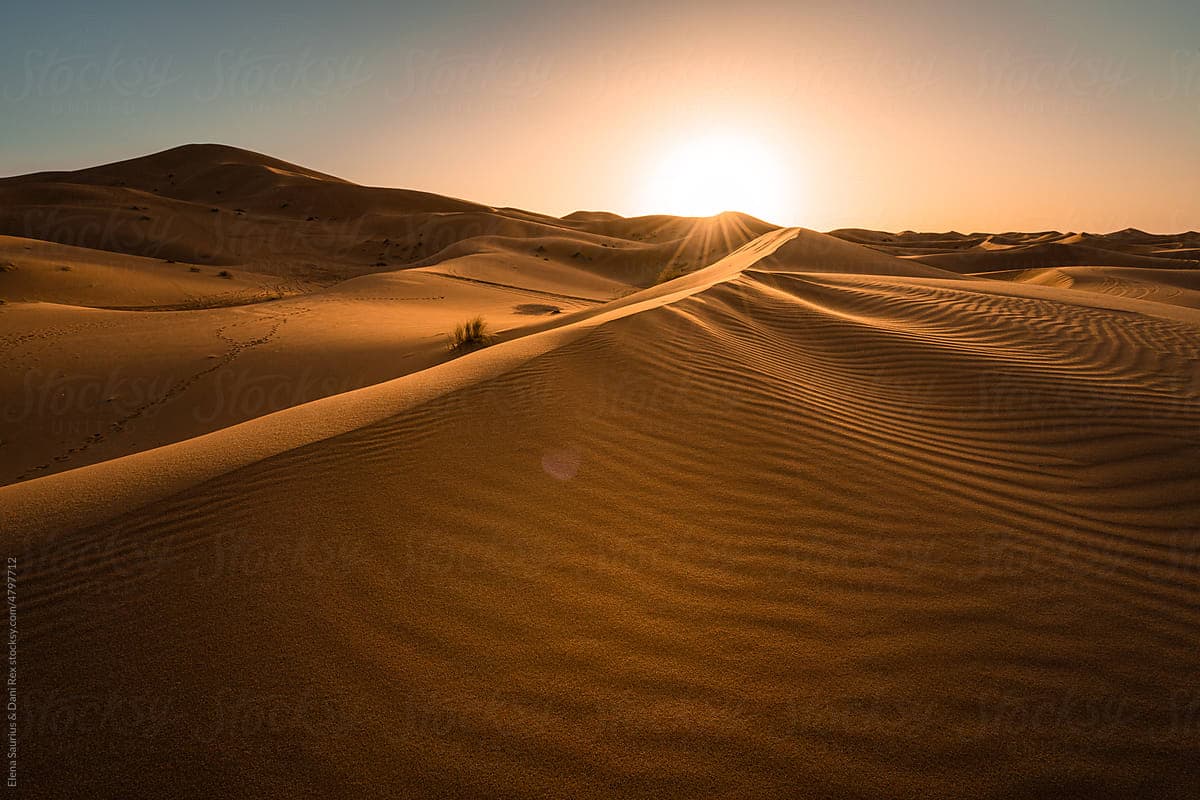
Erg Chebbi rises abruptly from a flat, dark stony plain called the hamada, which makes it one of the most dramatic sights in North Africa. The dune field is roughly 22 km long from north to south and only a few kilometres wide, so it feels compact and spectacular rather than endless. The village of Merzouga sits on its western side, with smaller settlements such as Hassilabied and Khamlia nearby. The highest dunes rise up to around 150 m above the plain, with sweeping views towards the Algerian border.
Erg Chigaga (M'Hamid El Ghizlane)
Erg Chigaga lies at the very end of the Drâa Valley, where the palm groves give way to open desert. M'Hamid El Ghizlane, "the plain of the gazelles", is the last village before the sand. The erg itself stretches for around 35–40 km from east to west, making it larger in extent than Erg Chebbi, although its dunes are lower and more scattered. It sits within the area of the Iriqui National Park, and to the west lies the dry bed of Lake Iriqui, a huge flat expanse that 4x4 drivers cross on the way to Foum Zguid. There is no village, no paved road and no electricity grid near the dunes – which is exactly its appeal.
Getting There: Access, Distances and Driving Times
Reaching Erg Chebbi
From Marrakech, the classic route crosses the High Atlas over the Tizi n'Tichka pass (about 2,260 m), continues through Ouarzazate and the valley of the roses towards the Dades and Todra gorges, then on to Tinghir, Erfoud and Rissani before reaching Merzouga. It is a long drive of around 550–560 km, so almost every tour splits it over two days with a night in the Dades Gorge or Todra area. From Fes, the road climbs through the cedar forests of the Middle Atlas near Ifrane and Azrou, passes Midelt and follows the beautiful Ziz Valley via Errachidia and Erfoud – about 460–470 km, comfortably done in one long day. This easy access is why Merzouga is the natural desert stop on a Marrakech-to-Fes (or Fes-to-Marrakech) journey.
Reaching Erg Chigaga
From Marrakech, you again cross the Tizi n'Tichka pass to Ouarzazate, then head south-east through Agdz and the lush palm groves of the Drâa Valley to Zagora and finally M'Hamid – around 450 km and 7–8 hours of driving. From M'Hamid, the paved road ends. A 4x4 then takes you about 55–60 km across sandy tracks, dry riverbeds, small dunes and stony plains, a journey of roughly 1.5 to 2 hours depending on conditions. Many itineraries return a different way: across the dry Lake Iriqui to Foum Zguid, then back to Marrakech via Taznakht and Ouarzazate. From Fes, Erg Chigaga is a stretch: it means driving south to the Drâa region via Merzouga or the Todra Gorge, so it is best combined with a longer loop rather than a short trip.
Dunes and Scenery
If your dream is the classic Sahara postcard – towering, knife-edged dunes rising like mountains – Erg Chebbi delivers it in a very concentrated way. The great "big dune" walks at sunrise are hard but unforgettable.
Erg Chigaga is gentler in height but bigger in feeling. Its dunes form long ridges and isolated peaks separated by sandy valleys, with views that often stretch in every direction without a single building. The landscape on the way in is part of the experience: acacia trees, nomad encampments, small oases and the shimmering flatness of Lake Iriqui. Photographers who love wide, empty compositions and a sense of scale often prefer it, while those who want maximum drama in every frame usually prefer Erg Chebbi.
Crowds and Atmosphere
Erg Chebbi's popularity is both a strength and a weakness. There are many camps scattered across the dunes, and in peak seasons (spring, autumn and the year-end holidays) you will see other camel caravans, quad bikes on the edges of the erg and groups climbing the same dunes for sunset. Choosing a camp located deeper in the dunes, or walking away from the main paths, makes a big difference, and the desert is still very peaceful at night.
Erg Chigaga has far fewer camps spread over a much larger area. It is common to see no one else on your dune at sunset, and the feeling of isolation is real – no lights on the horizon, no engine noise.
Desert Camps: From Simple to Luxury
Both deserts offer three broad levels of camp:
Standard or nomad-style camps: traditional tents with beds and blankets, shared toilets and showers (or very basic facilities), a communal dinner and often Berber drumming around the fire.
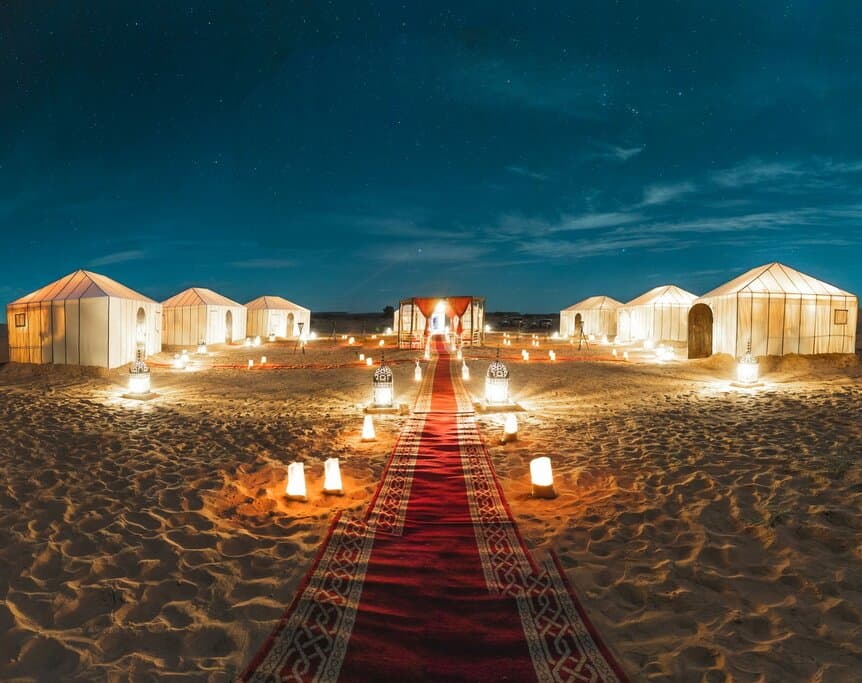
Comfort or "desert" camps: larger tents with proper beds and en-suite bathrooms, including flushing toilets and hot showers.
Luxury camps: spacious tents decorated with rugs, lanterns and furniture, private bathrooms, high-quality meals, sometimes private terraces, and attentive service.
Around Erg Chebbi, the choice is huge, from simple camps to some of the most stylish desert camps in the country. Because the camps are close to Merzouga, supplies are easy and amenities such as electricity (often solar) and hot water are more reliable.
Around Erg Chigaga, camps are fewer, and everything has to be brought in by 4x4, so comfort varies more. There are good comfort and luxury camps, but they tend to be more expensive for the same level of service, and simplicity is part of the charm.
Things to Do in Each Desert
In Erg Chebbi, the classic experience is a camel trek of around an hour to an hour and a half into the dunes at sunset, followed by dinner and a night in camp. Other popular activities include:
Sandboarding on the high dunes
Quad bike or buggy rides on the edges of the erg
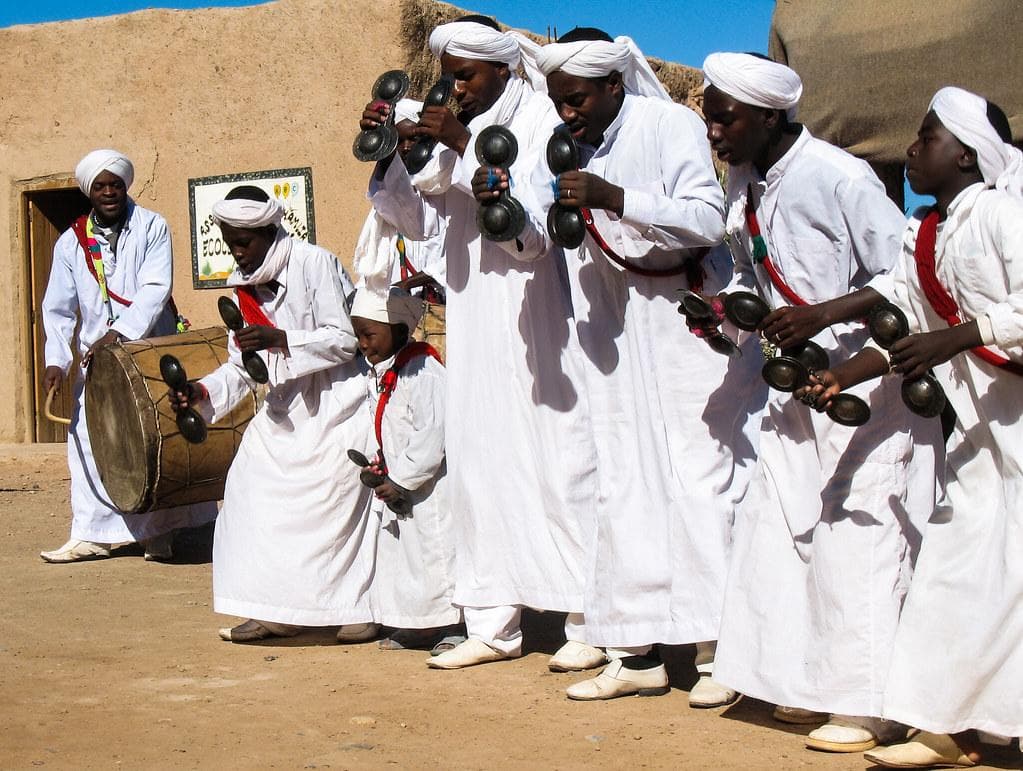
Visiting Khamlia, a village known for its Gnawa music
Exploring the Sunday market and old ksour of Rissani, and the fossil workshops around Erfoud
Meeting nomadic families on the hamada
In Erg Chigaga, the main activity is simply being there: the 4x4 crossing itself, a camel ride or walk to the highest dune for sunset, stargazing in very dark skies and sunrise in total silence. You can also:
Try sandboarding on the larger dunes
Take a multi-day camel trek from M'Hamid for real adventure
Cross the dry Lake Iriqui and spot desert wildlife and birds
Visit Tamegroute, famous for its green pottery and old Koranic library, and the kasbahs of the Drâa Valley
Cost Differences (Approximate)
Prices vary widely depending on the season, group size, camp level and whether you travel privately, so treat these figures as rough guides rather than quotes. As a reference, one euro is roughly 10–11 Moroccan dirhams.
Shared group tours from Marrakech to Erg Chebbi (3 days): often from around €90–180 per person (roughly 1,000–2,000 MAD) with basic camps.
Private tours to Erg Chebbi (3 days): commonly around €300–700 per person for two people, depending on vehicle, hotels and camp; lower per person for larger groups.
Private tours to Erg Chigaga (3 days): usually 10–30% more than a comparable Erg Chebbi trip, mainly because of the 4x4 transfer and camp logistics.
Luxury camps: from around €150 to €400 or more per tent per night, including dinner and breakfast.
In short, Erg Chebbi offers the widest range of budgets, including the cheapest options, while Erg Chigaga is rarely a budget choice.
Which Desert Is Best for You?
First-time visitors
For most first-timers, Erg Chebbi is the safer choice. The dunes are the most impressive in Morocco, the route passes some of the country's highlights, and the easy access means more time enjoying the desert and less time in a vehicle on rough tracks.
Families with children
Erg Chebbi again usually wins: paved roads, shorter camel rides, more comfortable camps. Erg Chigaga can work for older children who enjoy adventure, but the 4x4 section can be bumpy and long for little ones.
Adventurers and repeat visitors
If you have already seen Merzouga, or if the idea of crowds bothers you, Erg Chigaga is a wonderful choice. The off-road journey, the remoteness and the sense of space feel closer to the Sahara of explorers' tales.
Photographers
Both are excellent. Erg Chebbi offers higher, sharper dunes and strong colour contrasts; Erg Chigaga offers empty horizons, minimalist compositions and darker night skies for astrophotography.
Honeymooners and couples
Either can be very romantic with the right camp. Erg Chebbi has more luxury options and easier logistics; Erg Chigaga offers more privacy.
Alternatives: Zagora, Tinfou and the Agafay Desert
Zagora and Tinfou have small dune areas a few hours closer to Marrakech than the big ergs. A two-day trip lets you cross the Atlas, see Aït Benhaddou and the Drâa Valley and spend a night in a desert camp. The dunes are modest – do not expect the scale of Erg Chebbi – but it is a good option when time is very limited.
The Agafay Desert, about 40 minutes to an hour from Marrakech, is a stony desert rather than a sand desert, with rolling hills and views of the High Atlas. Its camps can be very comfortable, and it is perfect for a sunset dinner or a single night away from the city, but it is not the Sahara and has no real dunes.
Sample Itineraries
3 days: Marrakech to Erg Chebbi and back
Day 1: Leave Marrakech, cross the Tizi n'Tichka pass, visit the ksar of Aït Benhaddou and continue via Ouarzazate to the Dades Gorge for the night. Day 2: Walk in the Todra Gorge, then drive via Tinghir and Erfoud to Merzouga. Ride a camel into Erg Chebbi for sunset and sleep in a desert camp. Day 3: Sunrise on the dunes, breakfast, then the long drive back to Marrakech, arriving in the evening. This is intense; many travellers prefer to end in Fes instead.
4 days: Marrakech to Fes via Erg Chebbi
Day 1: Marrakech – Tizi n'Tichka – Aït Benhaddou – Ouarzazate – Dades Gorge. Day 2: Todra Gorge – Erfoud – Merzouga, camel ride and first night in camp. Day 3: A slow day in the desert: Khamlia and its Gnawa music, Rissani, nomad families, sandboarding, sunset on the high dunes and a second night in the desert or in a hotel by the dunes. Day 4: Drive north through the Ziz Valley, Midelt and the cedar forests of Ifrane to Fes.
3 days: Marrakech to Erg Chigaga and back
Day 1: Marrakech – Tizi n'Tichka – Aït Benhaddou – Ouarzazate – Agdz and the Drâa Valley, overnight in Zagora or a palm-grove kasbah. Day 2: Visit Tamegroute, continue to M'Hamid El Ghizlane, switch to a 4x4 for the off-road crossing to Erg Chigaga, camel ride or walk at sunset and night in camp. Day 3: Sunrise, then cross the dry Lake Iriqui to Foum Zguid and return to Marrakech via Taznakht and Ouarzazate.
4 days: Marrakech to Erg Chigaga with more time
Day 1: Marrakech – Aït Benhaddou – Ouarzazate, with time for the kasbahs and a night in Skoura or Ouarzazate. Day 2: Drâa Valley, Zagora and Tamegroute to M'Hamid, then 4x4 to Erg Chigaga. Day 3: A full day in the dunes: sunrise, a camel walk, sandboarding, rest in the shade and a second night under the stars. Day 4: Lake Iriqui and Foum Zguid, then back to Marrakech.
Best Time to Visit
The best months for both deserts are roughly October to April, with spring (March to May) and autumn (late September to November) often considered ideal: warm, sunny days and cool nights. In winter (December to February), days are pleasant but nights can drop close to freezing, so good blankets are essential. In summer (June to August), daytime temperatures commonly exceed 40 °C; trips are still possible, with activities early and late in the day, but not recommended for everyone. Late winter and spring can bring sandstorms and wind, especially in Erg Chigaga. If you want stargazing at its best, plan around the new moon.
What to Pack
Layers: light clothing for the day and a warm fleece or jacket for the night, even in spring and autumn
A scarf or cheche to protect your face from sun and sand (easy to buy locally)
Sunglasses, a hat and high-protection sunscreen
Comfortable closed shoes and sandals; walking barefoot on cool sand is lovely in the morning
A small overnight bag – large suitcases usually stay in the vehicle
A head torch, a power bank and a zip bag to protect your phone or camera from sand
Lip balm, moisturiser, wet wipes and any personal medicine
Some cash in dirhams for tips, drinks and small purchases
Cultural Tips
The people of the desert, many of them Amazigh (Berber) and nomadic families, are famously hospitable. Ask before photographing people, dress modestly when you pass through villages, and accept mint tea when it is offered – it is a sign of welcome. Keep the desert clean by taking your rubbish back with you, and respect the camels by following your guide's instructions.
Frequently Asked Questions
Is Erg Chebbi or Erg Chigaga better?
Neither is better for everyone. Erg Chebbi has higher dunes, easier access and more camps, so it suits most first-time visitors. Erg Chigaga is wilder, quieter and harder to reach, so it suits travellers who value solitude and adventure.
Which desert is closer to Marrakech?
Erg Chigaga is slightly closer in kilometres, but the final 1.5–2 hours are off-road, so the total travel time is similar. Both realistically need at least three days from Marrakech to enjoy without rushing.
Can I visit the Sahara in 2 days from Marrakech?
Two-day trips usually go to the small dunes near Zagora rather than Erg Chebbi or Erg Chigaga, because the great ergs are too far for a comfortable return in two days. For the real dune seas, plan three days or more.
How high are the dunes in Erg Chebbi?
The highest dunes of Erg Chebbi rise up to around 150 m above the surrounding plain, making them among the tallest in Morocco. Erg Chigaga's highest dunes are lower, generally around 50–60 m.
Do I need a 4x4 to reach Erg Chigaga?
Yes. There is no paved road beyond M'Hamid El Ghizlane, and the tracks to the dunes require a 4x4 and an experienced local driver. Self-driving in an ordinary rental car is not possible.
Is it safe to sleep in the desert in Morocco?
Desert camps in both Erg Chebbi and Erg Chigaga welcome travellers every night of the year and are generally very safe.
Plan Your Sahara Trip with Travsus
Whether you dream of climbing the tall golden dunes of Erg Chebbi or crossing the open desert to the remote silence of Erg Chigaga, the right itinerary makes all the difference. At Travsus, we design private desert tours from Marrakech, Fes, Casablanca and other cities, at your own pace and in your own vehicle. Tell us how many days you have, who is travelling and the kind of camp you prefer, and we will help you choose between Erg Chebbi, Erg Chigaga or a shorter escape to Zagora or Agafay, then build a journey around it. Contact the Travsus team through our website to start planning your Moroccan desert adventure.
- Erg Chebbi
- Erg Chigaga
- Sahara Desert
- Morocco Desert Tour