
Fes
Fes to Merzouga Desert Tour: 2 & 3 Day Guide
Plan your Fes to Merzouga desert tour: 2 & 3 day itineraries via Ifrane and the Ziz Valley, camel trek, desert camp, prices, best season and packing tips.
TRAVSUS
· 13 Min. Lesezeit
Dieser Artikel ist noch nicht in Ihrer Sprache verfügbar und wird daher auf Englisch angezeigt.
Few journeys in Morocco change scenery as dramatically as the road from Fes to the Sahara. In a single day you leave the medieval lanes of the world's largest car-free medina, climb through cedar forests where wild monkeys watch from the branches, cross the high plateaus of the Middle Atlas, follow a river of palm trees through a deep canyon and arrive, as the light turns gold, at the edge of the tallest dunes in the country. A Fes to Merzouga desert tour is the classic way to reach Erg Chebbi from northern Morocco, and it is one of the most rewarding road trips in North Africa.
This guide explains everything you need to plan it well: the route stop by stop, realistic driving times, how the 2-day and 3-day options differ, what a night in a desert camp is really like, approximate prices for private and shared tours, the best season to go, what to pack and how to choose the right itinerary for your travel style.
Fes to Merzouga Desert Tour at a Glance
Distance: roughly 460–480 km from Fes to Merzouga, depending on the exact route.
Driving time: about 7–8 hours of pure driving; plan on 9–10 hours with photo stops, lunch and breaks.
Main stops: Ifrane, Azrou cedar forest (Barbary macaques), Middle Atlas passes, Midelt, Ziz Gorges, Ziz Valley palm groves, Errachidia, Erfoud, Rissani and Erg Chebbi.
Tour lengths: 2 days (Fes – Merzouga – Fes) or 3 days (Fes – Merzouga – Marrakech, or Fes – Merzouga – Fes with a full desert day).
Highlights: camel trek at sunset, night under the stars in a desert camp, sunrise over the dunes.
Best season: March to May and late September to November.
Approximate cost: shared tours from around €90–200 per person; private tours usually €200–450+ per person depending on group size and camp level.
Why Start Your Sahara Trip in Fes?
Many travellers assume Marrakech is the only gateway to the Sahara, but for Merzouga, Fes is actually closer. The drive from Marrakech to Merzouga is around 550 km and crosses the High Atlas, while the road from Fes is a little shorter and passes through landscapes that most visitors never see: the alpine-looking town of Ifrane, the cedar forests of Azrou and the wide, empty steppes of the Middle Atlas. If your trip includes Fes, Chefchaouen, Meknes or Tangier, starting your desert tour here saves you an extra day of backtracking.
The Route from Fes to Merzouga, Stop by Stop
Fes to Ifrane (about 65 km, 1 hour)
Leaving Fes early in the morning, the road climbs steadily onto the Middle Atlas plateau. After about an hour you reach Ifrane, a town built during the French protectorate at roughly 1,650 metres of altitude. With its sloping red roofs, tidy gardens and lake-dotted surroundings, it is often called the "Switzerland of Morocco". In winter it can be covered in snow, and in summer Moroccan families come here to escape the heat.
Azrou Cedar Forest and the Barbary Macaques
A few kilometres beyond Ifrane lies the town of Azrou and the great Atlas cedar forest, one of the largest of its kind in the world. Some of these trees are several centuries old. The forest is home to the Barbary macaque, the only macaque species living in Africa, and you will often see troops of them close to the road.
A responsible tip: the Barbary macaque is an endangered species, and feeding the monkeys bread, crisps or sweets harms their health and makes them dependent on people. Watch and photograph them from a respectful distance, and a good guide will explain why.
Across the Middle Atlas to Midelt (about 125 km, 2 hours)
Beyond Azrou the landscape opens into wide high plains with flocks of sheep, Amazigh (Berber) shepherds and small villages of earthen houses. The road crosses the Col du Zad pass at more than 2,100 metres before descending toward Midelt, a quiet town sitting between the Middle and High Atlas ranges. Midelt is known as Morocco's apple capital, and on clear days the snowy peaks of Jebel Ayachi rise dramatically behind it. It is the usual lunch stop on a Fes to Merzouga desert tour.
The Ziz Gorges and the Legionnaires' Tunnel
After Midelt you cross the eastern High Atlas, and the scenery changes completely. The road passes through the Tunnel du Légionnaire, built in the 1920s, and then follows the Ziz Gorges, where the Ziz River has carved a deep, colourful canyon through layers of limestone.
Errachidia and the Ziz Valley (about 140 km from Midelt)
The gorges open near the Hassan Addakhil dam lake and the regional capital Errachidia. South of the city, the Ziz Valley becomes one of the most spectacular palm groves in Morocco: thousands of date palms stretching along the river, dotted with old kasbahs and ksour (fortified villages). The viewpoint over the valley, often with a small café and rug sellers, is one of the most photographed spots of the whole journey.
Erfoud and Rissani
Erfoud is famous for two things: its dates, celebrated each autumn with a date festival, and its fossils. The rocks around the town are rich in marine fossils such as ammonites and trilobites, and workshops polish them into tables, sinks and souvenirs. A little further on, Rissani is the historic heart of the Tafilalet region and the ancestral home of the Alaouite dynasty that still rules Morocco. Its traditional market is lively and authentic, and its big market days are traditionally Sunday, Tuesday and Thursday. Many tours visit Rissani on the way back rather than on arrival day, to make sure you reach the dunes in time for sunset.
Merzouga and the Erg Chebbi Dunes
Finally the tarmac crosses a flat, black stony desert called hamada, and suddenly the orange wall of Erg Chebbi rises on the horizon. These dunes stretch for roughly 25 km from north to south and some reach well over 100 metres in height. The village of Merzouga sits at their edge and is the starting point for camel treks and desert camps.
The Camel Trek and Your Night in the Desert
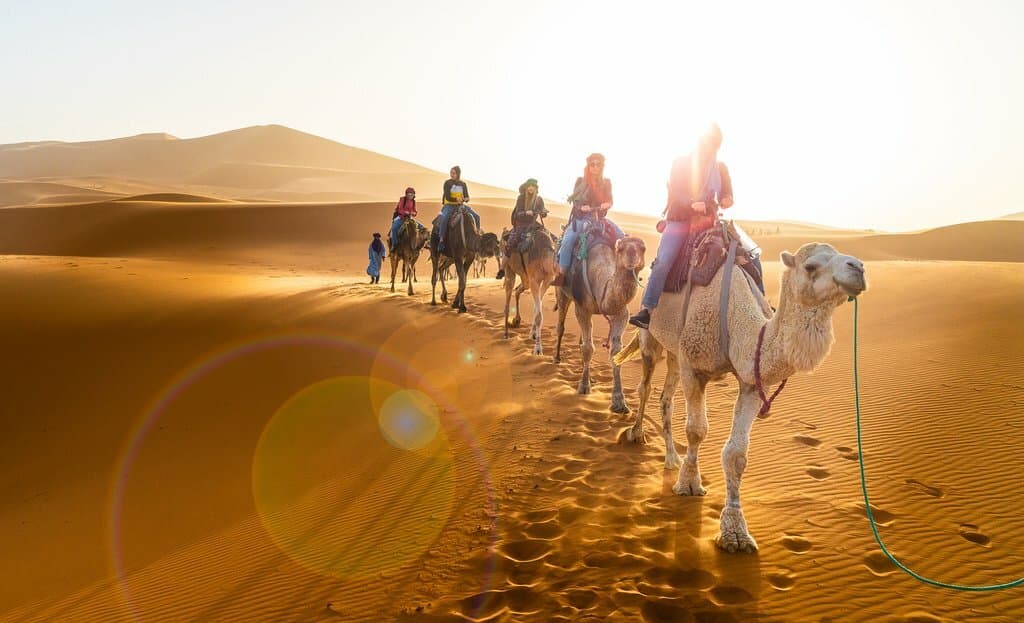
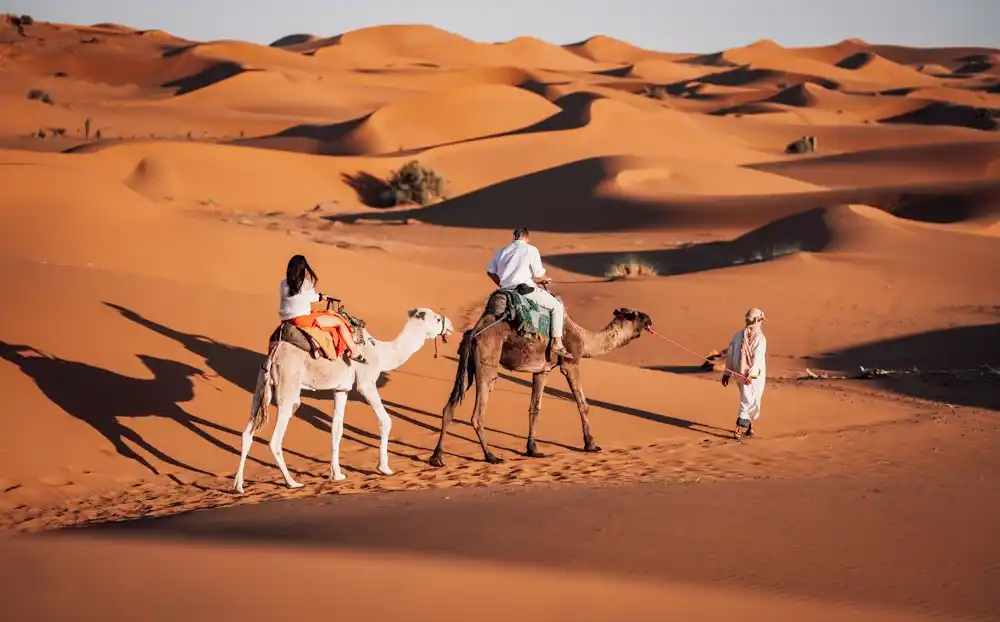
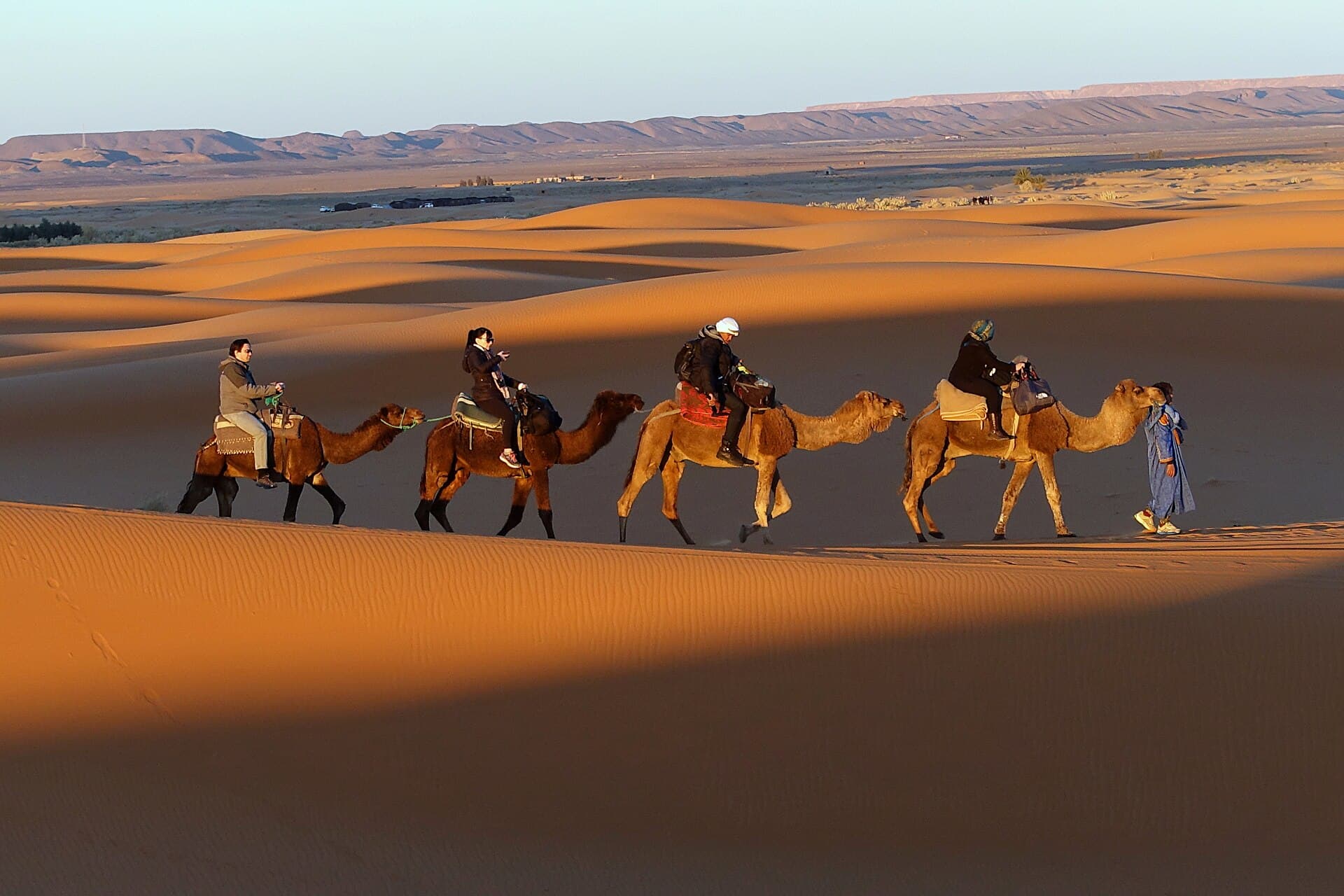
On arrival, you leave your large luggage in the vehicle or at a guesthouse and take only a small bag with what you need for the night. Your camel guide, usually a local man from a nomadic family, leads the caravan into the dunes in the late afternoon. The ride generally lasts between one and one and a half hours. Riding a dromedary feels strange for the first few minutes, then surprisingly relaxing: hold the handle firmly when the camel stands up and kneels down, lean back slightly going downhill and simply enjoy the silence.
Most caravans stop on a high dune to watch the sunset over Erg Chebbi, when the sand turns from gold to deep orange and then pink. You then continue to your camp, tucked between the dunes.
What Desert Camps Are Like
Camps around Merzouga vary widely, and the choice has a big influence on your experience and the price:
Standard camps: traditional nomad-style tents with simple beds and blankets, shared toilets and showers. Comfortable, authentic and good value.
Comfort camps: larger tents with proper beds and private bathrooms with a flushing toilet and shower inside each tent.
Luxury camps: spacious decorated tents, quality bedding, hot showers, generous dinners and extra touches such as private terraces or heating in winter.
Dinner usually includes Moroccan salads, soup and a tagine, followed by fruit and mint tea. Afterwards, the staff often light a campfire and play Amazigh drums. Then comes the moment many travellers remember most: lying on the sand far from any city lights and looking up at a sky full of stars and, on moonless nights, the Milky Way.
Sunrise over the Dunes
Your guide wakes you before dawn. Climb the nearest high dune, sit in the cool sand and watch the first light spread across the Sahara toward the Algerian border. It is quiet, cold and unforgettable. After sunrise you ride the camels (or, in some camps, take a 4x4) back to Merzouga for breakfast and a shower before the next stage.
2-Day vs 3-Day Fes to Merzouga Desert Tour
The 2-Day Tour: Fes – Merzouga – Fes
Day 1: Fes – Ifrane – Azrou – Midelt – Ziz Gorges – Erfoud – Merzouga. Camel trek at sunset and night in a desert camp.
Day 2: Sunrise on the dunes, breakfast, then the long return drive to Fes along the same route, often with a stop in Rissani or the Ziz Valley. Arrival in Fes in the evening.
The 2-day tour is ideal if you are short on time and want to see the Sahara without changing your base. Be honest with yourself, though: it means roughly 16–18 hours in the vehicle over two days. With a comfortable private car and a good driver it is very doable, but it is intense.
The 3-Day Tour: Fes – Merzouga – Marrakech
This is the most popular option and, for most travellers, the best one.
Day 1: Fes to Merzouga. Same as the 2-day tour: Middle Atlas, cedar forest, Midelt, Ziz Valley, camel ride and desert camp.
Day 2: Merzouga – Rissani – Todra Gorge – Dades Valley (about 300 km). After sunrise and breakfast you drive through Rissani and along the route of the old caravan towns to Tinghir and the Todra Gorge, where sheer rock walls of up to around 300 metres tower over a narrow passage. Walk through the gorge, then continue along the "Road of a Thousand Kasbahs" to the Dades Valley, with its famous winding road and strange rock formations. Overnight in a guesthouse or kasbah hotel.
Day 3: Dades – Skoura – Ouarzazate – Ait Ben Haddou – Marrakech (about 320 km). Pass the Valley of Roses and the palm grove of Skoura, then Ouarzazate, known for its film studios. Visit the UNESCO-listed Ksar of Ait Ben Haddou, a breathtaking fortified village of earthen architecture that has appeared in many films and series. Finally, cross the High Atlas over the Tizi n'Tichka pass at about 2,260 metres and descend to Marrakech in the evening.
The 3-Day Tour Returning to Fes
If you need to return to Fes, a 3-day itinerary lets you spend a full day around Merzouga: a 4x4 excursion around the dunes, the Gnawa musicians of Khamlia village, a visit to a nomad family, the ancient underground irrigation channels (khettaras) and Rissani's market. You then sleep a second night in the desert or in a guesthouse near the dunes and drive back to Fes on day 3. It is a slower, more relaxed way to experience the Sahara.
Which Option Should You Choose?
Choose 2 days if you only have a short window and need to come back to Fes.
Choose 3 days to Marrakech if you are travelling onward; it is the most efficient way to cross Morocco and see the gorges and Ait Ben Haddou.
Choose 3 days back to Fes if you want more time in the desert and less driving per day.
Private vs Shared Tours: Prices and Differences
Prices change with the season, the camp category and the number of travellers, so treat the following as approximate ranges rather than fixed rates (1 euro is roughly 10–11 Moroccan dirhams).
Shared Group Tours
Shared tours group travellers from different hotels in a minibus of up to around 15–17 people. A 3-day shared tour from Fes to Marrakech typically costs around €90–200 per person (about 1,000–2,200 MAD), usually including transport, the camel trek, one night in a standard camp, one night in a hotel, breakfasts and dinners. They are budget-friendly and sociable, but the schedule is fixed, stops are shorter and you may wait for others to be picked up.
Private Tours
A private tour means your own vehicle (usually a comfortable 4x4 or minivan) and driver, just for you. For two people, a private 2-day Fes to Merzouga tour often falls around €200–350 per person, and a 3-day private tour from Fes to Marrakech around €250–500 per person, depending on the camp level and season. The price per person drops as the group gets larger. A luxury camp can add significantly to the total.
What you get in return is flexibility: you choose your departure time, stop wherever you like for photos, take longer at places that interest you, adjust the pace for children or older travellers and generally enjoy a more personal experience.
Best Time to Do a Fes to Merzouga Desert Tour
Spring (March to May): perhaps the best season, with warm days, cool nights and green fields in the Atlas and oases.
Autumn (late September to November): pleasant temperatures and the date harvest in the Ziz Valley and Erfoud.
Summer (June to August): very hot in the desert, often above 40°C during the day. Tours still run, but camel treks happen late in the afternoon and early in the morning, and a camp with good ventilation or air conditioning makes a big difference.
Winter (December to February): sunny, clear days and magical light, but desert nights can approach freezing, and snow can occasionally close or slow the Middle Atlas passes around Ifrane and Midelt.
What to Pack for the Sahara
A small backpack for the night in the camp (your main luggage stays in the vehicle)
Layers: a light shirt for the day and a warm fleece or jacket for the night, even in spring and autumn
A scarf or turban (cheche) to protect against sun and sand
Sunglasses, sunscreen and a hat
Comfortable closed shoes or sandals you don't mind filling with sand
A headlamp or small torch
A power bank, since electricity in some camps is limited
Cash in small notes for drinks, snacks, souvenirs and tips
Alternatives: Bus or Self-Drive
By Bus
Supratours (the bus company linked to the national railway) and some other operators run buses between Fes and Merzouga, often overnight. The journey takes around 9–11 hours and is very cheap compared with a tour, but you will still need to organise your camel trek and camp separately, and you will miss most of the stops along the way.
Self-Drive
Renting a car is possible, and the main roads are generally in good condition. However, you need to be comfortable with mountain roads, slow trucks, animals on the road and occasional police checkpoints. The last few kilometres to the camps are on sand, so you will need to leave your car in Merzouga and arrange transfer to the camp.
Cultural and Practical Tips
Ask before photographing people, especially women and children in rural villages.
Dress modestly in villages and towns; covering shoulders and knees is appreciated.
Bargain politely in the markets of Rissani and Erfoud; it is part of the culture and should stay friendly.
Carry cash: ATMs exist in Midelt, Errachidia, Erfoud and Rissani, but cards are rarely accepted in small places.
Tipping camel guides, drivers and camp staff is customary if you are happy with the service.
Frequently Asked Questions
How long is the drive from Fes to Merzouga?
The distance is roughly 460–480 km. Without stops it takes about 7–8 hours, but on a tour you should plan on 9–10 hours including lunch, photo stops and short visits along the way.
Is a 2-day Fes to Merzouga desert tour worth it?
Yes, if time is your main constraint. You will see the Middle Atlas, the Ziz Valley, the dunes, a sunset, a night in the camp and a sunrise. Just be prepared for two long days of driving. If you can, add a third day to reduce the time in the vehicle.
Can I do a day trip from Fes to Merzouga?
Not realistically. With more than 15 hours of driving for the round trip, you would arrive after sunset and leave immediately. A minimum of 2 days, with one night in the desert, is strongly recommended.
How much does a Fes to Merzouga desert tour cost?
As a rough guide, shared 3-day tours start around €90–200 per person, while private tours usually range from about €200 to €500 per person depending on the duration, number of travellers, camp category and season.
Can I finish the tour in Marrakech instead of returning to Fes?
Yes. The 3-day Fes to Marrakech desert tour via the Todra Gorge, Dades Valley and Ait Ben Haddou is one of the most popular routes in Morocco and avoids repeating the same road.
Do desert camps have toilets, showers and Wi-Fi?
Most camps have toilets and showers, either shared or private depending on the category. Electricity is often solar-powered, and Wi-Fi or mobile signal varies from camp to camp, so it is best to treat the night as a chance to disconnect.
Plan Your Fes to Merzouga Desert Tour with Travsus
At Travsus, we are a Morocco-based team organising private tours from Fes, Marrakech, Casablanca and other cities to the Sahara, the Atlas Mountains and the imperial cities. Our Fes to Merzouga desert tours can be tailored to your dates, pace and budget: choose 2 or 3 days, finish in Fes or Marrakech, pick the camp style that suits you, from authentic nomad tents to luxury camps, and stop wherever the road inspires you.
With your own vehicle and driver, you can enjoy the cedar forests, the Ziz Valley and the golden dunes of Erg Chebbi at your own rhythm, without the constraints of a large group. Contact Travsus through our website to receive a personalised itinerary and quote for your Sahara adventure, and let us help you turn a long drive into the highlight of your trip to Morocco.
- Fes
- Merzouga
- Sahara Desert Tour
- Desert Camp